











Mapping Social Need Signals: Ep. 14 of the ‘No Wrong Door’ Podcast
No Wrong Door is a podcast from Findhelp that explores how social care delivery is evolving to better support whole person care. Hosted by Findhelp’s VP of Marketing Amy Gordona, the series features conversations with social care experts, healthcare and government innovators, and Findhelp leaders who are shaping the future of access, coordination, and connected care.
Each episode offers an inside look at the systems, decisions, and ideas driving change—and what it takes to build a social safety net that works at scale.

When we ask the right questions, a decade-plus of search data can tell a clear story about human needs. Since Findhelp was founded, millions of people have searched our network for food, housing, and essential support. Each search represents a moment when someone reached out for help. Together, these moments show patterns that no single search could reveal on its own.
In episode 14 of our No Wrong Door podcast, Findhelp host Amy Gordon sits down with Dr. Moriba Jah, the founder and chief scientist of GaiaVerse, a professor at the University of Texas at Austin, a MacArthur Fellow, and a former NASA spacecraft navigator. We’re partnering with GaiaVerse to analyze years of anonymized Findhelp search data to better understand the timing, context, and reasons behind why people seek help.
In this episode, we explore:

How responsible AI can help reveal nationwide patterns in food insecurity, housing instability, and policy impact.
Why analyzing search trends alongside weather, policy, and economic data creates a clearer picture of community needs.
How search data reveals the reality of survival mode when basic needs are threatened.
Watch episode 14: “Mapping Social Need Signals”
When community partners, health systems, and governments have clear insights, they can direct help where it matters most. Watch to the full episode to learn more about how Findhelp and GaiaVerse are working together to make social care more proactive and human-centered.
Key themes from the conversation
Leveraging artificial intelligence to understand human needs requires grounding complex data science in personal empathy and rigorous ethics. Moriba and Amy examine how lived experience, responsible AI models, and real-time search behaviors come together to transform how social care is understood.
Lived experience as the foundation for human-centered AI
Moriba’s perspective on social care is deeply shaped by his personal experiences. He survived childhood trauma, displacement, military school abuse, and personal food insecurity. Having experienced eating out of dumpsters while transitioning to college, Moriba views search data points not as abstract statistics, but as real people undergoing profound human struggles. This lived experience drives GaiaVerse to ensure technology serves as an instrument of restoration and stewardship rather than exploitation.
“I can connect to the people behind the data… The entire country is an entity or an organism… And the partnership with GaiaVerse is to help surface the meaning and the causal pathways of what this nation has been experiencing.”
Moriba Jah
Co-Founder & Chief Scientist
GaiaVerse
Chipping away at ignorance with responsible AI
Artificial intelligence can feel overwhelming or risky, especially when applied to human lives. Many traditional AI models try to guess missing information using probability. That approach can create false answers, known as AI hallucinations.
In social care, wrong information can cause real harm. GaiaVerse takes a different approach by focusing on what evidence proves to be false, eliminating wrong answers rather than making assumptions.
This process helps ensure that AI tools remain honest about what they do not know. By refusing to fill gaps with guesses, we can build tools that support decisions safely and protect individual privacy.
“Much like a sculptor, my block of marble is ignorance. I use data to chip away the ignorance.”
Moriba Jah
Co-Founder & Chief Scientist
GaiaVerse
Uncovering patterns from a decade of data
Social care needs do not happen in a vacuum. A natural disaster, a policy change, or a local business closure can affect a community for years. When organizations view these events in isolation, they miss how problems connect.
By combining 10+ years of anonymized Findhelp search trends with external sources like weather data, census reports, and policy changes, we can see cause-and-effect patterns across the country.
“By… bringing in external sources like multidimensional poverty index data, Census Bureau, weather… Now we have a more holistic lens through which to see these people that have real needs and real struggles.”
Moriba Jah
Co-Founder & Chief Scientist
GaiaVerse
Understanding survival mode and search signals
Social needs-related search data gives a direct view into what communities experience in real time. For example, early findings showed searches for the word “meals” jumped over 1,400% in 2026.
Search activity increased even before SNAP benefit cuts took effect, showing that people prepare for loss before it happens. When basic needs like food and shelter are at risk, people enter survival mode.
When individuals focus entirely on finding their next meal or a place to sleep, health or dental needs take a backseat. Recognizing these signals allows communities, nonprofits, and government agencies to prepare resources well in advance rather than reacting after families fall into crisis.
“We’re trying to help people better see and understand the people and patterns behind [the searches]… In order to hopefully prevent somebody from having to go through that trauma in the future.”
Amy Gordona
VP of Marketing
Findhelp
Restoring power and choice to individuals
Technology should always serve people first. Behind every search result is a person looking for support.
Data analysis is not about reducing people to numbers or statistics. Instead, it is about making sure unserved and unseen populations get the resources they need.
Using responsible AI, data helps build a social safety net that anticipates needs instead of just reacting to crises.
“For me, power is not the ability to control outcomes. It’s the ability to make choices.”
Moriba Jah
Co-Founder & Chief Scientist
GaiaVerse
KEEP LEARNING
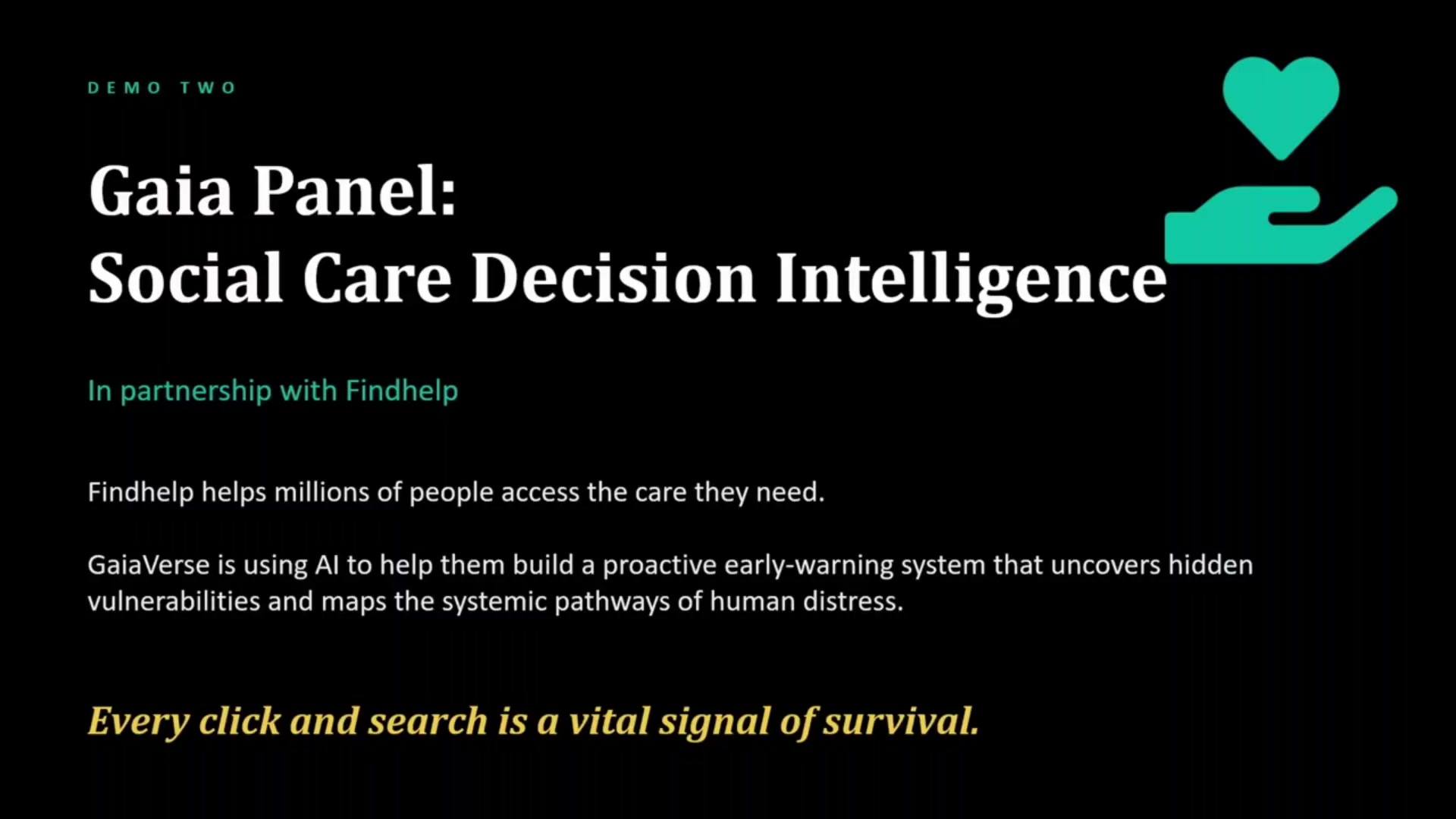
Moriba recently presented at the AI for Good Global Summit 2026 at Palexpo in Geneva, Switzerland.
In this clip he discusses our partnership and highlights our shared goal to turn data points into signals of survival.
What’s next for No Wrong Door?
“Mapping Social Need Signals” is available now—Episode 15 will be released on October 7 and features Findhelp’s VP of Community Solutions, Noah Harlan.
Subscribe to No Wrong Door wherever you listen to podcasts to be notified when new episodes drop: