










Designing Community Care Hub Infrastructure That Scales (and Lasts)
Findhelp Chief Operating Officer Jaffer Traish recently sat down with two experts—June Simmons, the Founding President and CEO of Partners in Care Foundation, and Robbi Kay Norman, the Co-Principal at Uncommon Solutions, Inc.—to discuss the history of the social safety net, where it’s heading next, and the emerging (and evolving) role of community care hub infrastructure.
As hubs expand across the country, organizations must figure out how to scale their work and make it last. They need secure technology, shared data standards, and clear billing processes.
In this post, you’ll learn:

The evolution and role of community care hubs.
How community-based organizations (CBOs) can more effectively partner with healthcare systems.
Why technology must support outcome measures instead of just counting referrals.
Watch | Designing community care hub infrastructure
Well, welcome. Thank you everyone, for joining. Excited to see a lot of familiar faces and friends and then also new folks to the conversation. My name is Jafar Trash. I serve as the chief operating officer at Findhelp and thrilled today to welcome you all to our webinar and discussion, keeping it, I think, fun and informal today on designing community care hub infrastructure that scales and lasts. So welcome. I am very honored today to have two incredible individuals who are leading significant transformation of this work across the country and have for quite some time. First, June Simmons, founding president and CEO, Partners in Care Foundation, one of the early and most transformational leaders in this space over many years. So thank you, and welcome to June Simmons. And we’re also very excited to have with us today Robbie k Norman, who is a leader at Uncommon Solutions, who has been entrenched in the work of understanding not only states’ needs, but also community needs and the role of hub and hub infrastructure, as we move forward in the transformation of social safety nets. So thrilled to have both of them with us today. Moving ahead, some quick housekeeping items. The webinar is being recorded. We will absolutely share the recording of the session in the coming days. Importantly, if you do have thoughts, comments, questions as we go through today’s discussion, please use the q and a tab on your screen. We’ll have some live q and a at the end of the presentation. If we don’t get to your question today, we’ll absolutely have some experts take a look and get back to you individually. So feel free to use that as we move forward. With that, I am going to kick us off today. And I think what’s important is the safety net in this country has been evolving as early as the seventeen fifties. And I share that to say our CEO found in a book a note from seventeen fifty three. It was from Chelmsford, Massachusetts, and it was a town council meeting. And the note said, mister Parker would take in a child from poor John Quarry who had been come… Become deceased to care for this child until eighteen years old on behalf of the family, receiving compensation for expenditures to care for this individual from the town. Seventeen fifty three, which is fascinating. Fast forward, in a book called a program of social reform. In nineteen ten, it was called out that accidents, illness, premature death, unemployment, and old age are hazards, that cause social risk and need a form of reconciliation. In that same book in nineteen ten, the comment was made, the dread of the pauper’s grave, meaning affording a burial, is the first major insurance program established to prevent falling potentially into poverty. So this challenge of modernizing, the social care infrastructure and ecosystem has been ongoing through experiments, across decades, if not a century or more. And that brings us to nineteen thirty five, the Social Security bill, with safeguards against the hazards of life, all the way through what we see here today. Many of you are probably familiar with Medicaid delivery reform, DISRIP, as many have heard, and, of course, that took place in New York, California, and Massachusetts with experiments for improving different types of services for that population. I’m sure many of you have also followed CMS’s AHC model, thirty two bridge organizations, testing screening and navigation services, the Camden Coalition, and many others publishing their findings and learnings from that experimentation. And then we get closer to today, with more modern, you know, CMS waivers and funding to support in part some hub infrastructure, like New York’s seven billion dollar, you know, waiver framework. But waivers are not the only way and certainly not CMS as being the only way to modernize and evolve how, community care can take place. So this is just an interesting component of our evolution and experimentation, and I think we’re entering the next age, which is the role of technology in modernizing how community care can take place. Fast forward, and this is a very basic diagram of which there’ll be more in the presentation from our colleagues with us on what’s evolving. And what’s evolving is the interconnection between health care and social care, but then also behavioral health and other needs. Managed care organizations, health systems, health centers, and other entities who are often overwhelmed with the clinical challenges they face, and they cannot always lend the staffing, the support, and the time needed to serve community, of which many community care hubs are beginning, to not only deepen their experiments but succeed in those connections to those that can provide services. But the question then becomes, what about security and comprehensive documentation, standards of care and pathways, codes to report and provide potential reimbursement for services, integrations into case management systems that are used by many, incentive payments and capacity building, you know, especially for those on the right side of this picture who are really the supply of the work we’re doing. So a lot of important topics as we begin to further experiment with hubs across the nation. Now for those of you that have been to the, Aging Disability Institute website, you’ve probably seen this map. If you haven’t, it’s really fascinating where, you know, through self reported responses, it’s a draft of the community care hubs across the nation. Some states have deeply accelerated the experimentation. Others are still in the beginning of their journey for what developing community care hubs can look like. And, of course, the partnership to align community care. So two really valuable resources here. If you’re only able to stick with us for fifteen minutes, these are two of the most valuable resources to learn more about what hubs are doing across the nation in their own experiments. So I wanted to put that here front and center. Now we’re beginning to see, I think, a lot of the models, maturing, including CMS payment models, Medicaid payments, in lieu of services for nutrition and medically tailored meal delivery, requirements in state managed, care plan contracts to support social care, and then most recently, an October twentieth deadline for states to use year one funding for rural health transformation and their related programs. So as we’re transitioning to a more permanent statewide scale of community care hubs, funding is shifting from short term or experimental government grants to reimbursement models, claim based models. And this means a big shift for the human service organizations who need to understand how to not only connect with hubs and other organizations, but to participate in a contracted mechanism to ensure capacity building, sustainability, and scale. So a really exciting time, but certainly a lot to learn by all of us. So that means we’re in an age of complexity. Health care is used to regulation, laws, coding. The social care sector is very mission focused, always dependent on funded blend… Funding blending, and now adoption of new technology to support standards and standards of care across, you know, these different ecosystems. So that is, I think, the precursor to, I think, what will be a fascinating conversation today. And with that, I’d like to welcome June Simmons to the stage and a chance for June to share more about how she’s navigating, you know, through this complexity. Well, thank you, Jafer. Glad you’re referring to partnership to Lyme Community Care, which I’m a co chair of. I think is a very important resource for all of this work, and I loved your history. Trained as a social worker, and social work began at Massachusetts General. If I’d realized you were gonna do that, I would have checked the dates when doctor Cabot first began to call on someone to help when people would come in and had no shoes or no coat in the cold weather. He said we can’t really achieve good health if we don’t address the fact that they have no place to sleep, that they don’t have food, that they don’t have things to protect them from the environment. So it’s it’s old work, but then as you say, building a really organized delivery system because most care occurs in a health care building. We have a system that pays for what some people call sick care after the fact somebody’s injured sick. We’re trying to move to predictive model of care, but it’s it’s a big… Very big change. So we’re looking now at what happens in the home. So if we look at the next slide… Sorry. There we go. And we we realize that’s that’s means we’re outside health care, go in for health care, come out, and what happens? And who administers that? And how do we make sure that all the things people need to manage to good health outcomes in partnership with their health care providers. How does how does that happen? And so in looking at that some time ago, the community care hub was thought of as a new innovation. Now It’s a thing. If we go to the next slide, let’s look at what what is the community care hub. And as Jeffers states so well, it’s a very complex system we have around health care. But a lot of it, most of us only spend a few minutes at a time, we hope, in health settings in the course of a year, only some hours in the health setting, then all the rest of the health care occurs in the community and at home and through a variety of agencies. So we’re trying to pull that together so that it’s coordinated. It’s shared information. It’s shared services. We get out. We try to avoid gaps and duplication. So here you see the hub, and the hub tries to make it efficient by bringing together groups of agencies across a geography. And those agencies, because they are community agencies, they’re very different than health care. So having the right insurance, having the right software, being able to go contract, having legal support. Not all agencies that we really want that are local and trusted have those resources. And if they did, then that means everybody has to contract with everybody. No. Thank you. We want to centralize contracting and bring a host… Bring a whole team of agencies together. To do that, if you see in the middle there, then the hub has to establish that system for health care for, as as Jeffers note, payment. This is a new thing. It’s revolutionary to pay for community services in this way to take health dollars and use them to pay for whole person care. So this idea of the IT infrastructure, which is critical, and data systems and reporting, but also credentialing the agencies, onboarding the agencies, providing them with safe and secure software, overseeing their practice, building tools to build new skills, and helping them report their work so that it is billable and then doing the billing for them and all the quality reporting and all the interface with the health plan. So the hub is bilingual, bicultural community and health care, health plan, health payment. So it’s it’s… Crosses these radically different sectors and and tries to respect the individuality of each and and bringing them together. If we look at the next slide, we can say, oh, well, this has been evolving for a while. It began as an innovation in two thousand thirteen. And at that time, the Hartford… Johnny Hartford Foundation funded Partners in Care and also HSpan, what is now HSpan in Massachusetts to build out the first hubs. So this began to evolve, but it began with a single statewide contract with one insurer, Blue Shield of California in our case. And so here, a small community agency on its own had to rise to building out services anywhere in California where there was a Blue Shield member and be able to provide the interventions, which were either the evidence based health self management programs coordinated to communities or individual care coordination. So this then evolved working with the administration on community living from day one, building this out, eventually getting NCQA standard for accreditation, building these systems that could translate a whole person community care, what happens at home, how do I care for myself, what do I eat, where do I live, how do I get care, into formal, compensable, meaningful, targeted, consistent services. So you see over time that that began to build until it really finally now has achieved a fair amount of recognition, but we’re spreading that further this morning. But, you know, all across the country, we are trying to speak across sector with technology, with health care, with community to build out this concept. And the two day portion on there, the health at home challenge is the first official formal recognition where CMS says the words community care hub. So if we if we look at the next slide, we can just note out of out of that… Because come a definition called advanced community care hub. So we’ve determined across the nation some standards, which you can find in the partnership to align community care website. There have been work groups working cross sector. This is such a new and bold design. It has to be co designed by all the systems that have to work together and find that better than not working together, contributing value, bringing meaningful positive change. So health plans, hospitals, physician groups, community based agencies, technology experts like Find Help have to come together and build this system. We’ve been doing that, as you saw, since two thousand thirteen. Now there’s twelve states selected that are considered advanced community care hubs because we’re old enough to to get out of, you know, babyhood into a reasonable degree of maturity. It’s still evolving, still needing to grow and become a mainstream, become a default, become a standardized part of care. So in California, see, well, at least we have a reasonable degree of growth. It’s an advanced community care hub. We have statewide coverage, not always even because we are going to build these services wherever there’s a payer that has a geography, a population, and a service need. And then that goes… Becomes a contract, and that becomes an organized local version of the hub. So across California, we have respite private duty services under Medi Cal Community Services, for example, And then managed Medi Cal plans can identify the people that need that and refer them into a fifty agency statewide system that can provide those services within the guidances and have a shared single billing system. Same for Meals on Wheels California as a newer service line. We have post hospital services to help people leave hospitals safely. Combined, you see last year, and this was an agency. We started as a small CBO. You know, CBOs are small. Still small rounding error compared to health care. We we… Well, I think we were about a nine million dollar a year agency. So now we’re about ten times that. But what’s great about the hub, we believe these services belong… Delivered by local community agencies and local people. And here is fifty million dollars that went out into local community agencies that couldn’t really build these contracts and all these services and be paid for them on their own. You’ll see this often in the Meals on Wheels groups are the newest to this, and they’re not used to any of these business practices. They don’t have these infrastructures, but they can get them through the hub. So sending that money out to strengthen community led services. We believe CBOs represent a specialty field of practice, one that’s been missing from medicine and one that can be integrated through this structure, serving this time forty thousand people, the hundred agencies. A good start, not enough. So as we know… So this is… On the next slide, we we see how this has evolved and become a very strong centralized infrastructure. We we think that dollars should go for services. Dollars should go to help people meet their essential needs, food, housing, transportation to other people or to medical services, but home modification, supplemental activities that they can master so they can personally manage their health care more strongly. So this, I think, is very important. And just… You see at the bottom there. So what does the hub do? Well, it shows up in health care settings, builds standing for the CBO community, and builds relationships that lead to contracts. So now we have thirty five major contracts. Many of them, Medi Cal, but Medicaid, but will be moving to Medicare as you’ll hear. A variety of services. So this is an organized local community delivery system that is multispecialty. If you if you realize… If you haven’t been watching as long as I have, this is what medicine did. We saw this in California because it went to managed care first. So we saw the medical practices do this. They did it by consolidation. We’re doing it by shared infrastructure. On the next slide then. About four years ago, the partnership to align community care was formed as a voluntary initiative because we saw, oh, this idea is beginning to take hold. It’s still young, still needs you to adapt it, support it, grow it, evolve it. But that group has been working very hard to define what it is to help right at this moment, bring comment to CMS about the physician payment rules so that they can be adapted to really support paying for community care. There have been number of efforts on the government’s part to support some of this. TCM and CCM to help people leave a hospital and stabilize safe at home, but they didn’t translate it so that it would work in the community. It was all licensed personnel. This was licensed personnel. Now we have recognized community health workers are crucial part of the system. Social work leadership, RN leadership, great. Community health workers, essential alternative workforce need to be equipped, need to be supported. So a lot of that work to define advances coming through the partnership to align community care. And then if we look at the next slide, then we know that the next evolution of this very important growth in the use of this model is the health and home challenge. I don’t know if you’ve been watching it, but this is the first time CMS through a c… Through the Administration on Community Living has built out an effort to identify and create a team to… If you… If we… We’re not looking at it now, but we saw that map of where the hubs are. Well, where are the hubs not? How do we manage to have an easy button for community? Tech can do it. AI, Zoom, you know, one contract cover everywhere. If broadband exists, if people can use that, you know, it doesn’t meet every need, but it’s certainly easy here. We’re building a whole system of care, and we need it to fill these white spaces on the map that you see here. Because these blue spaces are the selected states through the challenge. It’s not a grant. It doesn’t have a lot of money. It has momentum. It has the blessing of CMS through administration and community living to say, please scale community care hubs. They’re a crucial part of the delivery of whole person care. So now we’re moving from having established a number of statewide community care hubs. Now we’re gonna have to work hub to hub to each building. This whole initiative focuses on dually eligible. It focuses on this term that’s sort of new, the near duals, the people who are in the terror category. They can be wiped out, you know, huff, puff, and I’ll blow your house down. It doesn’t take many blows to take down some people’s finances if they have a health crisis or some other injury crisis. So looking then at the next slide, we see that a number of the applications by the community care hubs had to show close partnership with major health care leaders. Excuse me. We cannot build this as silos. This has to be shared building. The people who need these services are in health care. The dollars that we need to meet their health related social needs, some of them, and we hope most of them are in health care. We’re moving avoidable late stage care costs up front. We’re adjusting the total cost of care by changing the place, the timing, the nature of the interventions to really achieve health, best health across a population. People with low income are the highest need. Everybody else might need some of these things, but if you lack resources, you need it more. So here you see some of the powerful systems that have stepped up. Kaiser Permanente stepped up right away, ready to roll to think, okay. How do we scale this model? Common spirit, largest nonprofit hospital system in the country, Molina, Blue Shield Promise, HealthNet. So looking at the next slide, here we go. We’ve got to now diversify and expand funding. Grants, some places worked from grants. Grants don’t do. This needs to be mainstream. This is a real integrated system that links clinical and community in a meaningful way. And, therefore, we have to establish the funding streams, which we’re working on broadening the use of Medicare codes, TCM, CCM, the CHI and PIN codes, guide, a host of of others that are vital in helping provide navigation and coaching and support for people to find ways to better manage their own health care and achieve better outcome. So broadening adoption through health care, through talks like this. So if you have places for us to talk, you wanna join the partnership to align community care, you wanna be part of the solution. This is it as we all build an integrated infrastructure and prove value at call care. So please join us. It’s a movement. It’s a work of great import, And I know that you will really enjoy hearing the the next speaker who’s deeply involved in catapulting this work forward. This is a… An inflection moment. There’s so much chaos in the system. We have an opportunity to move in and build it better. So I’m excited for you to hear the next speaker. Thank you, June. That was wonderful. Very much appreciate what you’ve shared, and, we’ll invite Robbie to the stage as the next speaker. I’ll just share that, you know, I learn something new every time you share your evolution with with your hub and and national work, and you’ve proven that the funding can be obtained. You’ve proven that you can enter into contracts with the complex health care payers and system. You’ve proven that you can serve not just Medicaid, but also, you know, others and and duals. You’ve you’ve proven that the experimentation, there’s room for it, and you’ve proven the outcomes, you know, over time. So I think there’s so much that others can learn from you. But I think the point you are alluding to and Robbie will also make is other hubs don’t have to start from scratch in figuring out all of those processes, whether it be That’s right. The contracting, the technology, the training, the, you know, the… You know, working with with CMS and and others. So so much to learn. With that, I’m gonna turn it over to Robbie to get into our next, conversation. Thank you so much, Joffer. And, of course, it’s always just a pleasure to work with both, you and June in this space. I do think it’s a little unfair, Joffer and June, that you gave me the technology portion, the most boring portion of this conversation, but it is a very, very important, conversation to the sustainability of Community Care Hub infrastructure. And with that in mind, I love the history lesson that that both of you gave in this space, and I think there’s a real history lesson in the way technology is gonna be a support and enabler to the way community care hub infrastructure becomes sustainable. But what’s important to always remember and we can never forget is, people help people, and people close loops. Technology is just the enabler. And so we’ve gotta keep that front and center as we think about what the technology opportunity and also what the risks are in this space. And I would love… Because I know we’ve got a lot of people on this webinar today, throw into the chat for the find help team any technology barriers that you’ve had. Just throw out one over the course of the years and working in this space. Whether you’re a community care hub today, whether you wanna be one tomorrow, or whether you’ve tried to work with one over the course of of the last few years. Throw something in the chat that’s really been **** ** a technology front. And what I’m gonna do today is talk a little bit more about what the opportunity is, but also the challenges that we face and what we need to do about them. So with that in mind, there’s more than four friction points to technology in the community care hub space, but here’s the biggies. Right? Here’s the ones we talk about, think about, and, often, have pain about. We know the first one. Joffre talked about it eloquently as always, data standards, critical component to to this work. And, although we’ve worked really hard at clinical data standards and there’s a lot of really cool projects out there, the gravity work, etcetera. What we haven’t done is really gotten clear on the community data standards and how it relates to the clinical data. So we’ve got work to do there. There’s friction one. And the reason this is important to understand is that we shouldn’t be building technology unless we understand what we’re working up against and what we’ve gotta make sure we don’t keep repeating. Friction two is community care hub infrastructure for sustainability, it will have to have access to some degree to clinical data. And the reality is vice versa. Our health system and payer partners, they’ve got to have access to the community side of the data. If we’re ever gonna tell the true ROI story of this or total cost of care reduction we’re all looking for, we have to actually solve this problem together. Friction three is an old age story of just being able to ensure we have shared care plans, that we’re not working off, we’re not working with an individual in different spaces in different times when we’re when we’re both are all trying to support one individual, through their journey of health and social care. And friction four is the biggie. Right? It’s the one that kinda holds us all up in this space, and that is a longitudinal record. Now there’s lots of ways to look at longitudinal records and some… Right? There’s a lot of disagreement on what that looks like. But at the state level, we have to have strong longitudinal records, whether it’s through a health information exchange or a community information exchange or in the perfect world, they’re one and the same. And we also have to have them at the community care hub level. And I’m gonna talk to you also about those strong longitudinal records, right, in other spaces in this ecosystem of care. So there’s our four friction points that we’re gonna talk about today. Not all of them are gonna solve… This is not all the problems we need to solve. There’s just a few. Joffer only gave me fifteen minutes, so we’ll just solve a few today or talk about a few today. Okay. A couple of messages, for today’s conversation that I want us to keep in mind. One is is that reusable data integration processes are important. And what that means is that we can’t just keep building and adding appendages to our tech. We can’t just keep responding to a funder and initiative and then expect community care hub infrastructure and the beautiful network partners that they, support to deliver care. We can’t just keep adding new ways of of trying to collect data for every initiative, every reporting requirement. We’ve gotta really understand what we’re trying to build from the outset and make sure we build towards that. Data’s gotta move seamlessly between our referring partners, our payers, throughout the hub infrastructure to our network partners back and forth, and that’s the goal. So reusable data integration, something to keep in mind as we move through this process. But here’s the big deal. We need an infrastructure, a a technology infrastructure that is actually supporting our outcome measures. If we just keep building tech that’s about referral and screening counts, we’re gonna lose. We’re gonna lose in the ROI conversation and the total cost of care. What we know is community care hub infrastructure is incredible. It’s an innovation that needs to keep going. It’s doing incredible things in the field across the nation, and it supports hundreds and hundreds of network partners across the field. We need to keep that up. We need to keep growing that. But if our technology infrastructure is actually just hitting widgets, we’re gonna always fail in this space. So how do we get beyond that? Well, first, a community care hub infrastructure has to understand very clearly all the service lines it’s going to implement in in… With partnership with its network. And it has to know the standards of those service lines very quickly, and it has to also know what the reporting requirements are gonna be to the payers and funders. Together, those define what the data standards need to be and what the tech functionality needs to be to support itself. It’s not the other round… Other way around. Tech doesn’t drive reporting. Service lines and care drive reporting. That drives our data standards as well. So those are… We gotta kinda work backwards the way we’ve been working in this space. Okay. So what does this mean in real life? June did a beautiful job and is one of the most advanced community care hubs in the nation of describing what a community care hub infrastructure is. It’s robust as she described it. It has strong IT infrastructure. But what’s important to understand is that if you don’t really have a clear handle on your service lines that you’re providing from lower intensity community based care, navigation all the way to higher intensity case, case management or care management with care planning, right, assessments, and also the way you actually move through a place based. Right? Community based care transitions as well. If those service lines aren’t clearly defined and the standards in which you’re operating to, then it is very hard to know what your IT infrastructure has to do to support your network and to support the funding and reporting requirements of your funder. This is a whole person care coordination ecosystem across the lifespan, across geography. That means this community care hub infrastructure has to have a nice set of those core services, but it’s supporting hundreds and hundreds of community based organizations in its network to deliver to those services. So this tech stack has to be able to support the network and those referring or paying partners in that in that ecosystem of care. And, of course, there’s resources that are invaluable that we have to connect each individual in our network to. Evidence based programs. We know what they are. Whole person community care supports. And we also need to make sure that we could be nimble and mobilize in an emergency response, a flood, a fire, a pandemic. And we also need to be able to have a care team approach in the way we work in our network, in and out of that network. So this IT infrastructure has to support this whole ecosystem of care, and those service line standards and reporting requirements should be driving it. So what is happening nationally? June spoke of the health at home challenge and a beautiful initiative that’s really letting us look across the nation about what does it look like to have a mature or advanced community care hub infrastructure. And what that means if you go to the… I’ll flip to the next slide. What that means is that we need to know what mature or advanced really looks like. So we talked about it a little bit, but what we’re looking at here is a maturity model of the community care hub infrastructure. And what you’ll notice in the advanced column here is that at a federal level, funders are looking for exemplary IT infrastructure. Great. So that’s what they’re looking for. But what does that actually mean in real life? And what does it mean for the network that it supports? Because what we don’t want is to build robust IT infrastructure hundreds and hundreds and hundreds of times. We wanna make sure that these community care hubs are built to have lots of community based organizations to be able to dock to them so they can provide that infrastructure so we can do exactly what June said, get more services to people. More services to people, not more infrastructure. But what is it? On the… In the tech stack world, it’s all of these functions. So here’s eight of them. Eight major functions that a community care hub technology has to be able to perform to. And you know them well. These aren’t new, but they are complex at times. So we know intake, referral, and routing. Yep. There’s a tech component. We know that we have to make sure that we have an identity or matching, an individual to care so we’re not duplicating records. We know that we gotta have consent and manage that consent within a tech, stack as well. Eligibility, big one. Number four. This one is really driving, our inability to deliver care well in this space is easy eligibility checks and how we can actually manage that inside of a tech stack as well. That’s a big state problem, a national problem we gotta talk about more, but the hubs do have to be responsible in this space. Five, they have to have a client management application or system that allows them to document the kinds of care across those service lines. And five, six, and seven become the kind of trifecta technology stack that has to really work together. How you’re documenting care for an individual and how you’re paying for the care of the individual and how you’re reporting the care back to the funder. Those three really need to work more as a united infrastructure. And right now, every one of these tech, components that we just talked about are often operating in silos, right, in the way, we deliver care in this context. So we’ve gotta get better at our tech stack, working, cohesively in this way. Eight is a biggie. June talked about it. We’re in a cutting edge time of governance, data standards, interoperability. And what that really means is that we have a higher standard of the way we’re housing data, the way we’re sharing data. Are we meeting FHIR standards? And and are you actually able to share data in a comprehensive way in the right way at the right time, to the right people? So those are the biggies for the Community Care Hub infrastructure. And what we don’t wanna ever forget, though, is the community care hub is as good as its partners. And what that means is that if your referring partners don’t also meet a standard for their technology and data exchange, and your network partners also don’t meet a standard, right, this ecosystem actually doesn’t work. So let’s break that down a little bit further. Your referring partner is the entry into the Community Care Hub infrastructure. They send the referral, and they wanna know what happened with that referral. Right? And, hopefully, they’re your payer because that would be ideal. And they’re… They now send you a good referral. That’s their requirement. The community care hub, I described what they have to do, right, in pretty good detail, but the network partner also has a responsibility. And we’re gonna talk about all three of this in relationship to then a statewide longitudinal record, HIE, CIE, health information exchanges, or community information exchanges, which every state looks slightly different. Hopefully, they’re one and the same, but they are not always. And we need to talk about how that works in this community care hub sustainability strategy as well. So we talked about the hub. You’re gonna get these slides. Here’s the major, tech stacks that they have to accomplish, but let’s make sure that we’re not unclear on the referring partner requirements. They too have to be able to do those things that we just talked about. Refer, check eligibility, hold consent, document what what care has already been given, but they have to be able to exchange the right data, quality data, not giving poor referrals, but good referrals to the community care hub. And then they need to have a mechanism to be able to receive the information back, the status of what happened with that individual. That’s a key component of the technology stack or this ecosystem of care working. If you’re a call center, for example, a two one one, a nine eight eight, a nine one one, what we’re seeing in the field right now is they too have to be able to meet data standards. They have to be able to refer and exchange adequately and be able to accept, appropriate status of that individual and that referral back. That’s the ecosystem of care that allows us to really understand how well we’re doing in delivering care in our communities. Our network partners also have a responsibility in this, work. They too have to be able to ingest a referral. Although they are transactional in their data, meaning they need to document the delivery of service that they’re giving into either their own native system that meets the standards of a community care hub or in the best of all worlds is they’re utilizing the community care hub infrastructure so they don’t have to build their own. And they too have to be able to document well, check eligibility, do consent, and, and and be able to then, work with their resource partners that they’re gonna get their individual connected to. So here’s a deep dive into the entire tech stack that’s required for community care hub infrastructure to be effective. When you put it all together, it has to also connect to a statewide infrastructure at some point for a health information exchange or a community information exchange layer. This is the ultimate solve, right, for understanding statewide what our longitudinal records are really gonna look like for each individual and how we do not keep duplicating reentry, asking the individuals the same questions over and over again, rechecking eligibility, and, ensuring that they… The individual is the goal here, that they get the best care at the right time without having to reintroduce themselves over and over and over again. It all comes together in this incredible tech stack picture, and it’s gonna require a lot of innovation. It’s gonna require a lot of that codesign that June talked about. It’s gonna require us being innovative and mission driven in the way we use technology to support us in delivering care better, but ensuring that the individual is always at the center of our our driving technology for community care hub infrastructure and sustainability. Making sure the technology is supporting the network in delivering services best and keeping them nimble and doing what they do best, which is supporting people in getting the… Their needs met. It’s ensuring that it’s not too cumbersome for the workforce, the community based workforce, the community health workforce, the peer workforce, the navigation workforce that can’t be so big that they can’t utilize it. And we have to make sure that we never forget our referring partners, our funders. They too have to be part of creating this technology innovation, ensuring we’re meeting standards, and that we’re getting the right data in the right place at the right time safely. And that is it for me. Thank you, Robbie, so much. What you’ve really displayed, and I know you can’t read all the words on the screen, it’s a playbook. You’re you’re you’re forming, you know, I I think, a a well documented summarization of all the things that someone who’s early in their journey, mid journey, validating the journey can help evaluate themselves against and understand, you know, where where there may be more opportunities to deepen not only their technology infrastructure, but their alignment of that infrastructure with their partners on either end of the equation, you know, that you shared. So it’s very helpful, and I I hope those on the line, that I’m seeing in chat are giving some good takeaways. So thank you, Robbie, and we’ll get to some q and a in in just a moment or two. I will move us to just a couple last items and then really open up for some questions and some conversation. Many of you in the chat have have called these items out. Well, what about those standards? How do I find them? What about interoperability? Not only with my payer partners or my network partners, but but what about the systems that those partners are using? How can I see the whole picture? You know, understanding privacy in every state is actually managed a little bit differently. So these are many of the themes, and we’re glad that you’re you’re bringing them up. Many states have solved these in in very creative and intelligent ways. One of the first, of course, is really that shared longitudinal record. And in this picture, that medical group might use, e clinical works. The food pantry, you know, might use a small case management system, city government, homegrown, workforce development, a state agency system, the hospital, you know, might use Epic. Is that wrong? Is that bad? Certainly not. They’re picking tools that work for them and their staff for strong adoption. But how do we ensure that that data can move between each of these systems with standards that, you know, many of us are helping co develop at a national level for adoption? This is just the find help version of how we do that, meaning the privacy information that we see here for an individual’s record at the top left, that approval could have come from a statewide consent infrastructure, or it could have come from a hub that gathered that consent previously. We’re just interoperating that data so the right organizations can see it. What about previous assessments that may have been done by a payer or a hospital or a federally qualified health center? How do we bring that information front and center? What if another organization does one here? How do we see that all in historical context with the answers, you know, to those questions? And the same thing for goals and notes and referrals. What if other partners made referrals? We don’t want to duplicate or, you know, waste time. We want a more trauma informed approach to that care delivery. So this is just an example of that longitudinal record ingesting interoperable data from other sources. So big picture, all three of us have described, you know, what that end to end can look like from defining the network partners all the way through potentially submitting claims and receiving reimbursement, whether it be CMS, private sector, or even philanthropic, you know, investment, in in service delivery. So we’ve covered, I think, a lot here, and Robbie spoke to these. But in in one specific, you know, view, which is the reimbursement view, having that identity matching, having the eligibility for those specific services really becomes something that technology can assist in. And as an example, with some of the hubs that we work with in New York’s hub model, they go through a sophisticated identity and member verification process that actually integrates with the state’s, you know, Medicaid data roster to really validate accuracy on a month by month basis of who’s enrolled, who’s disenrolled, when services are capped or capitated, or even in some cases must end because of Medicaid enrollment. That information is so so critical. And in some states, there’s even more sophistication such as getting provider attestation to validate that an individual does have the clinical or social risks or needs that then justify or establish the basis of eligibility for a particular social care services, like in New York with utility assistance, rent assistance, home remediation, where attestation can be added to the platform to understand the eligibility basis. And the ability to document services rendered. June mentioned, you know, PIN codes, and, you know, there’s there’s, you know, new codes that seems released, you know, every quarter or so on on care coordination for, you know, Medicare or duals. This is important to capture. I saw a recent study that a large hospital system, academic, had missed about twenty million dollars in reimbursement because their community health workers simply didn’t know that they could use those specific codes, which would justify hiring more community health workers, you know, for their community. So definitely an opportunity to codify and capture where CMS already has the funding and and support, you know, for this type of reimbursement. And certainly, those that are less familiar with what the GRAVITY project and what, you know, CMS and other collaborators have been doing is establishing a framework for what are called LOINC codes, ICD ten diagnosis codes, SNOMED codes, HCPCS codes for billing, which at every step of the journey in the hub infrastructure or in the referral systems, this coding can be captured. And that supports not only long term reporting, but also transaction level intelligence about what the needs are of the community and what is being, reimbursed. So just an example for those, that haven’t seen. Robbie also mentioned something really important before before we get to the end here, which is integration with statewide health information exchanges, with state governments, what are called data warehouses of capturing this data on a population, oftentimes, that is the driver of increased funding and recognition of some of the challenges in communities. And this is just an example of some, you know, new standards under the h l seven organization that support being able to bundle this information and share it at that state aggregate level to support some of that decision making. So this is a a part of the New York state requirement for the hubs to operate, you know, in in this manner. And one of the folks in chat, you know, mentioned interoperability. Well, I’m proud to say not only is it possible, but it is real. Meaning, there are vendors out there who are willing to ensure that a referral can go from one system to another in the workflow of that network partner or in the workflow of that MCO partner and so forth. So it is possible. It is real. It can be done. We’re we’re in the modern age. It does sometimes take some work and some funding, but at the end of the day, this is live. This is making many more happy users. So we’re pleased to continue to support interoperability. Some in the chat have asked, are there case studies about other states? What hubs are doing? There definitely are. And I think Robbie and June and myself are likely more than happy to hear from you over email and and, you know, from your teams to share more of these types of case studies where not only can there be cost savings, but reductions in hospitalizations, in ED visits, like the MassHealth case study. This just happens to be the first year of three New York hubs who had, I think, close to now over thirty million dollars in social care reimbursements, where they’re beginning to demonstrate not just cost implications for these Medicaid members, but also significant partnerships with the supply side of of the network partners to keep this information moving forward. So lots of case studies out there. We wanted to also share the partnership to align community care has a great website as we shared earlier. Here’s a QR code. Assuming it works, if it doesn’t, let us know, and we’ll make sure to email it to everyone, the link. But lots of resources for hubs that are in the middle of of this journey as as many of us are. So I will move to the q and a and and pause here. We’re, I think, on on good time, and we’ll welcome back our our colleagues, June and and Robbie. Maybe, Robbie, a first question for you. Someone mentioned that very small local organizations really don’t have funding for technology. And so how can they truly participate? Is there an expectation that they do need to find funding or can they just tag on to systems that already exist by the hubs? Yeah. That’s definitely a role of the hub is to provide the software. Now Robbie travels across a variety of hubs. So Robbie, I’m interested in how you answer this question. So I think, the question is actually perfect. The the idea is that community care hub infrastructure does need to be able to cover a a a large market, geography, and volume, and that means it’s supporting hundreds and hundreds of community based organizations in being able to do exactly what you’re worried about. If hundreds and hundreds of community based organizations have to build the kind of tech stack that we’re talking about, it doesn’t make sense. And it actually holds them back from doing what they do best, which is meeting people where they are, the trust that they have with their community, and serving people and getting them connected. They’re scrappers. Right? They get people connected to all the things that are out there and what exists. As resources dwindle, we need less community based organizations trying to build robust, technology infrastructure, and they should be docking to these community care hubs. But the community care hubs has to be sophisticated in themselves to be able to support those networks. And they’ve gotta be able to receive this service information from all those agencies and consolidate into the kind of reporting that’s been agreed to with whoever they’re contracted with. So for example, we work with Kaiser. Kaiser gets audited by the state. We need to provide all this as part of their audit of this whole program. And if it’s clean, strong, and good, then we win together. They’re really looking for quality outcomes, but all the ability to meet their own accountabilities to the people they work with. So it’s it’s vital tool across the whole system. Thank you thank you both. For those that can stick on for two more minutes, we’ll get a couple more questions and then make sure that we get back to others. There was another comment about what other national what other hubs are are adopting these types of models, you know, across the country. Are there tested models? There certainly are. And of those seventy or so hubs, many of them are trying different approaches, different funding, you know, being blended and braided, different, you know, focuses such as housing versus, you know, food or, you know, the Medicaid population. So we’ll absolutely, you know, share, I think, and follow-up some some more of those models. A question that I’ll take, there was a good question on user fees, and subscription fees per user impacts how orgs can make the best use of these platforms, and that’s a really good point. I won’t speak for other platforms, but, that was a principle Find Help made about fifteen years ago is that it’s a flat license and it’s an unlimited number of users and will never charge a per user fee. And that allows organizations to flex and innovate and expand and work with their community, you know, to their heart’s content. And so that is really important, and we’d love to see more SDOH platforms and, hub platforms adopt an unlimited, you know, user approach. So I think that’s spot on. Another question is there are… Well, someone said there are many SDOH platforms out there. How can they communicate with each other like health records do? And, you know, oftentimes, people want this natively integrated into their health record. I’ve been tackling that challenge for the better part of ten years and today we integrate with about seventy five different EHRs. But every EHR has a different level of ambition of how deep they want that integration to go. I’m pleased that, you know, Epic and three or four others have adopted fully native integrations now where you never have to leave your EHR workflows, and you can do all of your work inside of your existing tool. Salesforce actually does that, you know, with us now as well, and that is increasing happiness and adoption. So, again, it’s possible, but that EHR has to come to the table, you know, as a partner. And and many of you have that voice, to help them come to the table. I am going to just share, you know, maybe closing comment from June and Robbie before we wrap. June, anything you’d like to just wrap us up with today? Well, this is just such a wonderful opportunity to really address a great human need across our country, especially in these times of increasing costs with extended lifespan and more and more opportunities for people to manage their health favorably. So this this coming together to function as a village on behalf of much better population health in partnership with each other, with the government, with technology. This is an inflection point for us to seize. This is really a moment to go. So we hope you’ll join us. Join the partnership. Follow Health at Home. Stay in touch with… Find help, and Uncommon Solutions might wanna talk with you too. Robbie? Robbie. Yeah. Just a big, shout out to bringing this conversation, to the field, Joffer and, of course, June. And I think, outcome focused data standards should drive what the technology needs to do for us. And I just appreciate, Jeff, for finding help always being mission driven in the way you approach, the way we’re really gonna deliver care more efficient, more efficiently and with more impact in our community. So let’s just keep up the good work. It’s hard work, but let’s keep it up. And you said it well, it can be done. Let me say one more thing, Jeff, if I may. Right now, the… It’s an opportunity to comment on the physician payment rules for Medicare. And you can go to the website at partnership to align community care. By the fourteenth, we have to do it. And we have tools. We have templates. We have sample letters. The opportunity to make sure that those rules support this kind of work, it’s crucial. So step up for that. That’s something you can do right now. So we hope you’ll join in that. Well, thank you, June. Thank you, Robbie. This was truly a pleasure to have this discussion, and thank you all who joined us for the conversation today. We’ll most certainly follow-up with those questions we couldn’t answer and also with the recording, you know, for all of you. And good luck in your journey with modernizing your your hubs and collaborating with the communities, and we’re here to not only cheer you on but be resources for you as well. So thank you all, and enjoy the rest of the day. Thank you.
Key themes from the conversation
The shift from grants to reimbursement
The social safety net in the United States has greatly changed over the last few centuries. For example, in 1753, a town council in Massachusetts paid a local man to care for an orphaned child. By 1935, the Social Security bill was signed into law to provide safeguards against life’s hazards.
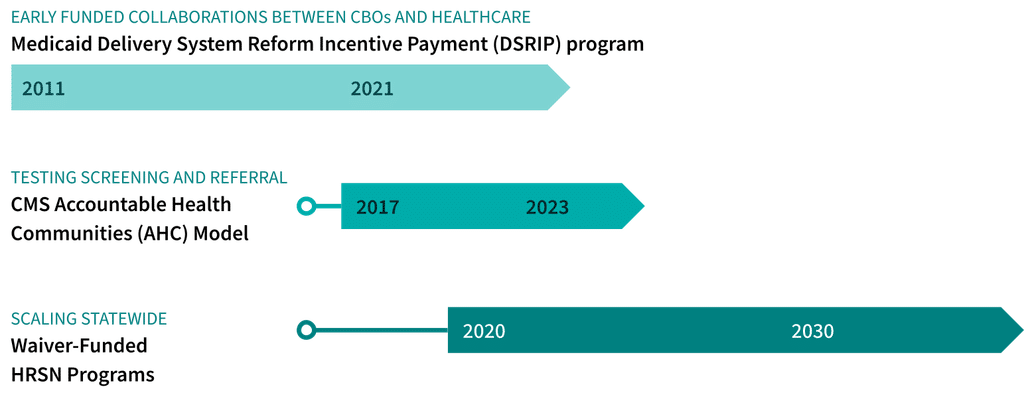
Today, Medicare and Medicaid programs regularly include social care in their payment models, including Medicaid 1115 waivers. But this shift requires a new way of operating: Human services organizations need to understand how to interact with healthcare payers and use claim forms to secure reimbursement for provided services.
“So as we’re transitioning to a more permanent statewide scale of community care hubs, funding is shifting from short term or experimental government grants to reimbursement models, claim-based models.”
Jaffer Traish
COO at Findhelp
Integrating community care into healthcare
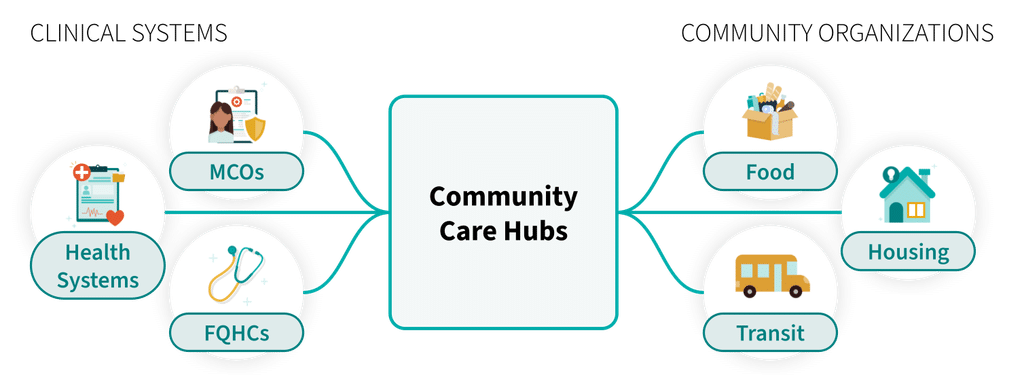
People spend very few hours of their lives inside a clinical building. Most health care happens at home and in the community. Community Care Hubs bring together groups of agencies across a specific area to coordinate this care outside the doctor’s office.
June Simmons noted that community-based organizations (CBOs) are specialists. She shared, “We believe CBOs represent a specialty field of practice, one that’s been missing from medicine and one that can be integrated through this structure…”.
However, smaller CBOs cannot easily contract with massive hospital systems on their own. The hub steps in to centralize contracting, credentialing, and billing. Hubs make it easier for healthcare dollars to fund social services.
“The people who need these services are in health care. The dollars that we need to meet their health-related social needs, some of them, and we hope most of them, are in health care.”
June Simmons
Founding President and CEO at Partners in Care Foundation
Technology that supports sustainable care
Modern tools can connect these disconnected sectors. Robbi Kay Norman discussed four major friction points that hubs face today:
1
Defining clear community data standards.
2
Gaining access to clinical data to prove return on investment.
3
Creating shared care plans so professionals aren’t working with individuals in different spaces at different times.
4
Establishing a strong longitudinal record to track a person’s entire care journey.
Our solutions help customers integrate social care into their existing workflows. Findhelp provides a shared, read-only social care record so partners can see needs assessments, referrals, and goals. This ensures efficient service delivery for everyone involved.
But technology must do more than just send a referral. Robbi explained that systems must focus on true impact.
“If we just keep building tech that’s about referral and screening counts, we’re gonna lose. We’re gonna lose in the ROI conversation and the total cost of care.”
Robbi Kay Norman
Co-Principal at Uncommon Solutions, Inc.
Learn how to process reimbursement and build a network that lasts
The full discussion covers much more ground:
- Robbi dives deep into the specific eight functions a hub’s technology stack must perform to succeed.
- June shares exact details on how her organization grew its budget tenfold by securing 35 major contracts.
Watch the webinar recording for these and other insights, and connect with our team to learn how our technology can support your organization.
KEEP LEARNING
We help Hubs simplify the complicated process of connecting people to help, managing partner capacity, and proving the return on investment (ROI) that keeps programs funded.
Whether you’re navigating complex Medicaid 1115 waivers or scaling local initiatives, we configure our platform to meet your goals, so you can turn inbound social care needs into verifiable, life-changing outcomes.
Powering Community Care Hubs