












Find Help Idaho: One Community Doorway for the Entire State
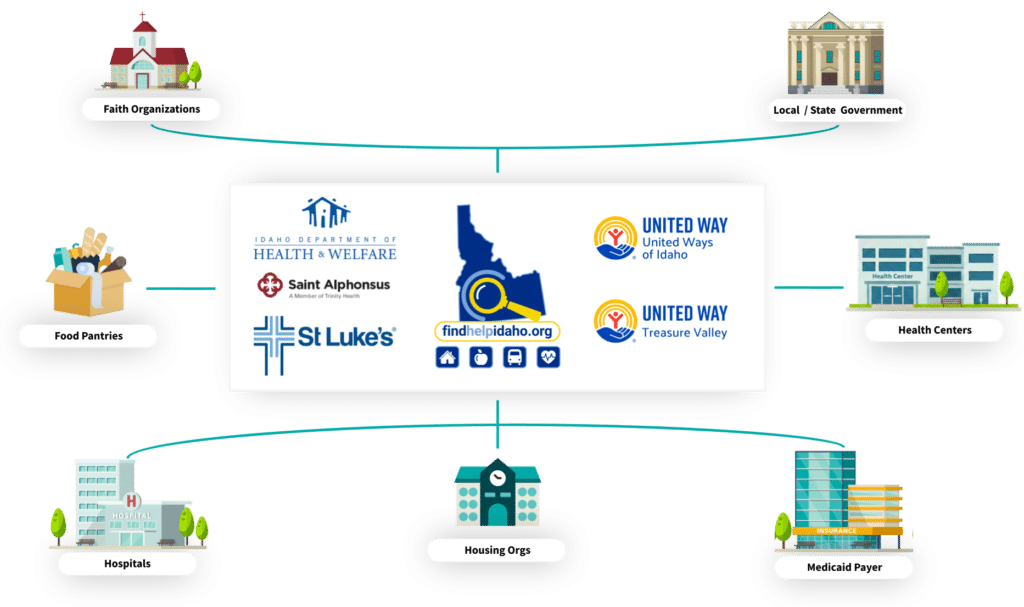
Establishing a single, connected entry point for social care across an entire state takes strong collaboration. In Idaho, state leaders, a local United Way, healthcare systems, and the state’s 211 call center came together to build a unified approach to health and human services—Find Help Idaho.
We’re excited to celebrate our ongoing partnership with the Idaho Department of Health and Welfare (DHW), Idaho 211, and United Way of Treasure Valley. Together, this cross-sector coalition powers a statewide Community Care Hub through FindHelpIdaho.org.
By combining the reach of state government, the trust of United Ways, and the efficiency of Findhelp’s closed-loop social care technology, Find Help Idaho is creating a true ‘no wrong door’ model for connected health and social care.
In this post, you’ll learn how:

Idaho evolved from regional networks into a statewide Community Care Hub
Alignment between state agencies, 211, and United Ways expands access to care
Findhelp supports statewide Hubs across the country
The evolution of Find Help Idaho
Idaho’s decade-long journey toward a unified social care network started at the local level. In 2018, hospital systems launched disparate regional tools to address needs identified in Community Health Needs Assessments (CHNAs). These tools had different resource databases and inconsistent workflows, causing confusion for both community organizations and residents.
By April 2022, the Idaho Health Data Exchange (the state’s health information exchange, or HIE) collaborated with health and community leaders like the United Way of Treasure Valley to launch a shared statewide tool: Find Help Idaho, powered by Findhelp.
In 2025, the United Ways of Idaho assumed statewide leadership of the Find Help Idaho initiative. Major healthcare providers across the state—including St. Luke’s (Idaho’s largest employer) and Saint Alphonsus (a member of Trinity Health)—integrated their own versions of Findhelp directly into their electronic health record (EHR) systems, while promoting Find Help Idaho as a shared community site to their patients.
“What’s unique about Idaho is FindHelpIdaho.org, which is one community doorway for the entire state.”
Anne Wolverton
Director of Community Impact
Building a true ‘no wrong door’ model for social care
Local navigators across various sectors are using the Find Help Idaho platform to help neighbors thrive.

Public Schools Navigator
“I was able to connect a family that just immigrated to Idaho with dental, housing, and legal assistance. I love having this tool and being able to share it with others.”

Community Paramedic
“Sometimes people need to be pointed in the right direction and this resource can be useful. I think it should be easy for patients and providers to use.”

City Representative
“Find Help Idaho offers a wealth of resources, making it an encouraging and user-friendly tool for the public to navigate services independently.”
“It’s exciting to see an entire state come together to support its most vulnerable. The entire United Way network in Idaho, led by the United Way of Treasure Valley, is working with the State, 211, and healthcare organizations to ensure each community has a voice and can create impact in a collaborative ecosystem. Hats off to the United Way and 211 network in Idaho for their visionary work on behalf of every Idahoan.”
Dallas Mudd
Sr. Director of Partnerships
Supporting rural health
Accessing current information about community resources (and how to apply for services) can be extra difficult in states like Idaho with large rural populations. According to an Idaho Department of Labor report from November 2025, 88% of Idaho’s land is classified as rural, representing 28% of residents. As the largest United Way in Idaho, serving 50% of the population, United Way of Treasure Valley has a deep understanding of the challenges people face when looking for help.
“We also offer some local technical assistance. So we have our great partners at Findhelp that are able to provide that, but then especially in our rural communities, they want someone that’s gonna come out and sit with them at the computer… This really has allowed us to give [the site] as a gift to our nonprofit partners.”
Anne Wolverton
Director of Community Impact
Creating a consistent navigation experience with Idaho 211
Unlike many states where United Ways operate the 211 system, Idaho’s 211 is managed directly by the Department of Health and Welfare (DHW).
Laura Denner, administrator of DHW’s Division of Family and Community Partnerships, and her team set out to ensure that families seeking support don’t fall through the gaps in the safety net.
By connecting 211 with Find Help Idaho, state call operators and self-navigating individuals use the exact same verified resource database.
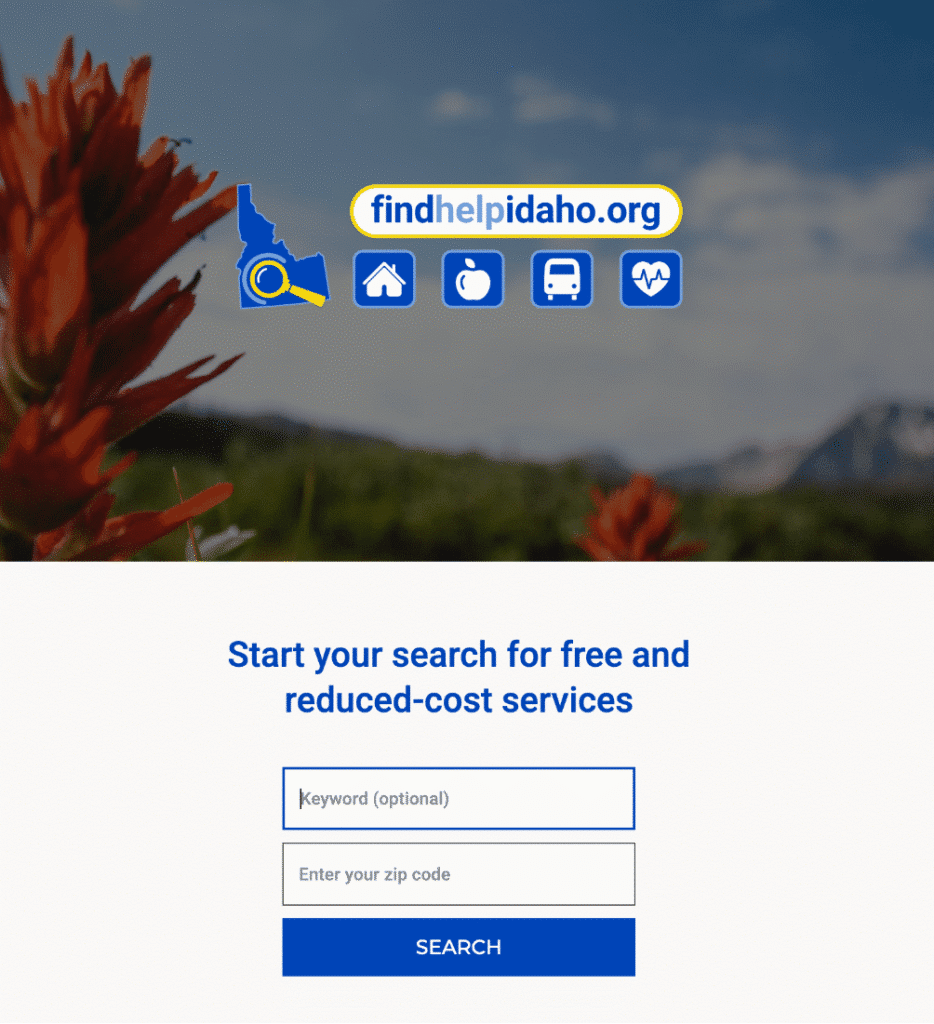
“We have all of our great nonprofit systems. We have government agencies, school districts, so many community partners that are also pointing to Find Help Idaho. So no matter who you’re talking to in our state, you’re getting the same resource when it comes to self-navigation.”
Anne Wolverton
Director of Community Impact
Focus on foster care
The Idaho Behavioral Health Council, which brings together the three branches of government and other partners to develop strategies to improve the state’s behavioral health system, identified foster care prevention as a top priority. Find Help Idaho is a big part of their initiative to keep families together by addressing social needs before they reach a crisis point that necessitates child welfare intervention. Laura from Idaho DHW shared with Idaho news station KMVT11 the compelling data that lead to the foster care initiative.
“Our data that we’re starting to pull reflects that over 97% of the families that are working with navigators never enter child welfare in the next six or 12 months, so really exciting upstream prevention and case management happening there.”
Laura Denner
Administrator of Idaho’s Division of Family and Community Partnerships
Beyond resources for families, navigators are also using Find Help Idaho to connect young people resources. From scholarship programs, job training, mental health care, and other stabilizing services, these connections also support substance use prevention.
Engaging CBOs
The scope of Find Help Idaho as a statewide network involved systems-level change for participants with different goals and needs. Knowing this, leaders were prepared for an uphill battle when it came to brining community organizations to the table. Instead, they were pleasantly surprised when they experienced the opposite.
“People wanted to hear about this new tool, especially when you can go to a CBO and say, ‘I have a way for you to get free data that you can use when you’re writing for grants, when you’re reporting to your board’. Being able to provide those tools to people was a really easy way to get in the door… We’ve been able to do a really good job making this a statewide effort and getting hand raisers from across our state to get involved.”
Anne Wolverton
Director of Community Impact
Reaching the ALICE population across Idaho
About 43% of Idaho households fall into the ALICE category (Asset Limited, Income Constrained, Employed) or live below the federal poverty level—representing roughly 833,784 residents who struggle to afford basic necessities.
Searches on Find Help Idaho currently engage about 10% of Idaho’s ALICE population. United Way of Treasure Valley’s shared goal with state and local leaders is to expand outreach into every urban and rural town. Creative local strategies are helping drive awareness to meet this goal. For example, the City of Boise prints QR codes linking to Find Help Idaho directly on utility bills. This gives residents facing financial strain an easy way to find assistance.

Find Help Idaho featured on Idaho Power’s bill assistance webpage
Powering statewide networks
Idaho is part of a growing national movement toward connected community care infrastructure. Our technology powers statewide coalitions and Community Care Hubs across the country:
Pennsylvania’s “PA Navigate“
Overseen by the Pennsylvania Department of Human Services, PA Navigate is a statewide, cross-sector initiative administered by four Health Information Organizations (HIOs)—Central PA Connect, ClinicalConnect, HealthShare Exchange, and KeyHIE.
PA Navigate brings together 35 healthcare provider organizations and hundreds of community-based organizations to coordinate care across regional coalitions.

New York’s “Social Care Networks“
Under New York’s 1115 Medicaid waiver, the New York State Department of Health created regional Social Care Networks (SCNs).
Findhelp serves as the technology partner for SCN leaders like SOMOS Community Care, Western New York Integrated Care Collaborative, and Forward Leading IPA (FLIPA) to support screening, closed-loop referrals, and claims reimbursement workflows.

Tennessee’s “Community Compass“
Connecting TennCare (the state Medicaid agency), all three managed care organizations (Wellpoint, BlueCare Tennessee, UnitedHealthcare), and local service providers, Tennessee Community Compass is a centralized system.
The platform supports referrals, service authorizations, data exchange, and CBO payments for over 1.4 million TennCare Medicaid members.
When organizations across industries align through interoperable technology, whole person care becomes a reality.
Strengthening safety nets, together
We’re proud to support the Idaho Department of Health and Welfare, 211 Idaho, and the United Ways of Idaho as they lead the way in connected care. To explore how our technology supports United Ways & 211s and statewide Hubs, schedule a demo with our team.