











Advancing Social Care Interoperability: Findhelp Is a Registered Specialty Exchange in Maryland
We are proud to announce that the Maryland Health Care Commission (MHCC) granted Findhelp regulatory approval as a Specialty Exchange to support secure social care data exchange across the state. Today, we’re sharing more about what this means for interoperability, whole person care, and rural health transformation.
This designation reinforces our role as a technology partner—not a replacement—to traditional Health Information Exchanges (HIEs). Findhelp captures social care and health-related social needs (HRSN) data, embeds closed-loop workflows directly into electronic health record (EHR) systems, and feeds these critical insights into HIEs. This enables providers to access a whole person view without additional administrative or data collection burdens.
We’re proud to be the first and only social care platform listed on the MHCC HIE registry. We offer Maryland health systems, primary care practices, and county health departments a Best in KLAS, state-cleared solution to fulfill social care requirements for Rural Health Transformation Program (RHTP) grants. Together, we can connect rural patients to whole person care.
In this post, you’ll learn:

What our designation as a Specialty Exchange means for Maryland healthcare organizations.
How Maryland RHTP grant awardees can fulfill mandatory social care requirements.
How Findhelp already collaborates with regional and statewide HIEs in other states.
Supporting Maryland RHTP grant awardees
The Maryland Department of Health recently announced $80 million in Rural Health Transformation Program (RHTP) awards to strengthen healthcare access and change the lives of rural residents who have historically struggled to find and get connected to support. Under Pillar 2 of this initiative, grantees must screen patients for health-related social needs (HRSNs) and establish technology connections with local CBOs.
This is where Findhelp comes in.
Because the Commission granted Findhelp specific regulatory exemptions tailored to social care, our technology gives Maryland RHTP grant awardees a direct pathway to satisfy reporting requirements.
Our designation as a Specialty Exchange gives Maryland providers—including county health departments, health systems, Federally Qualified Health Centers (FQHCs), and independent primary care clinics— a state-cleared pathway to screen for social needs, send closed-loop referrals, and satisfy the RHTP reporting requirements without adding duplicative administrative tasks.
“Building on existing data-sharing infrastructure and partnerships can promote greater sharing of social needs information and support the State’s broader health care transformation goals. Findhelp’s registration as a specialty exchange represents an important step toward connecting clinical care with community-based resources and interoperability across platforms.”
Douglas Jacobs, MD, MPH
Executive Director
Partnering with HIEs to unify social and clinical data
States have invested significant resources into HIE infrastructure, and that foundation makes exponentially more impact when social care data is included.
Rather than replacing existing HIE infrastructure, we‘re bridging the gap between clinical care and social care.
Our ongoing collaboration with CRISP DC shows how this can work:
- Organizations using Findhelp can opt in to share referral data with CRISP DC.
- Social care updates populate the CRISP Referral History tab.
- Clinical care teams get a complete view of a patient’s social needs and active referral statuses alongside their medical records.
When a patient visits an emergency department or primary care clinic, providers can see existing community support and seamlessly pick up in-progress referrals so that patients don’t fall through the cracks.
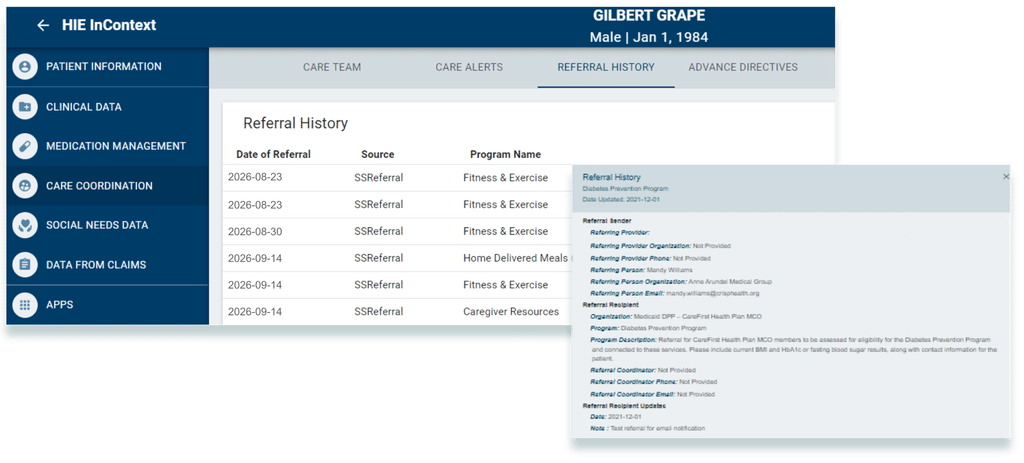
The CRISP DC Referral History tab integrates closed-loop social care referral data alongside clinical records.
Proven impact across statewide networks
Our work in Maryland builds on successful statewide social care initiatives across the country, where interoperability drives clear results for care teams and communities.
New York’s Social Care Networks
Under New York’s 1115 Medicaid waiver, Social Care Networks (SCNs)—led by SOMOS Community Care, FLIPA, and WNY Integrated Care Collective—rely on Findhelp technology to connect Medicaid members with essential housing, nutrition, and transportation resources. By integrating directly into regional workflows, we help SCNs coordinate care and meet state reporting guidelines.
A core requirement of the waiver is seamless data sharing. To achieve this, Findhelp established a first-of-its-kind, direct connection with New York’s HIE, built on modern, federally-recognized data standards. Our approach moves beyond legacy methods, embracing HL7® FHIR® (Fast Healthcare Interoperability Resources) Bundles to ensure social care information flows securely and efficiently between SCNs, healthcare providers, and the State.
This approach transforms care delivery:
- Bundling information dramatically reduces the number of requests for patient information, giving care teams immediate visibility into a patient’s journey.
- Aligned with Gravity Project guidelines, our data integrates natively into hospital EHRs and clinical systems without compatibility barriers.
- Consenting patient records flow straight into provider EHRs, placing vital HRSN data directly in clinical workflows.
“A mother postponed cancer treatment because she was afraid of losing her housing. By covering rent and providing food support during treatment, FLIPA removed the barriers keeping her from care. She is now pursuing treatment and recovering without fear of eviction.”
Patient Navigator
Finger Lakes Region
Pennsylvania’s PA Navigate initiative
In Pennsylvania, the Department of Human Services launched PA Navigate—a statewide collaboration powered by Findhelp and administered by a consortium of four regional HIEs. The network links 35 health systems, regional managed care organizations, and thousands of CBOs through single sign-on EHR integrations.
Dr. Valerie Arkoosh, Secretary of the Pennsylvania Department of Human Services, noted that from her clinical practice: “I saw so many things that were impacting the health of my patients that I could not write a prescription to fix“.
Built on the state’s HIE infrastructure, PA Navigate aims to make social care information more accessible, reusable, and actionable across organizations while reducing duplication and improving coordination. The long-term goal? Make social care data as shareable and connected as medical data.
By connecting healthcare providers and community partners, PA Navigate achieved significant success:
- 278% increase in referral resolution through CBO grant incentives and streamlined digital tools
- 32% decrease in emergency department utilization by high-risk patients, confirmed by HIE data tracking.
- 84% social care gap closure through targeted regional hub interventions for participating families.
“The healthcare community talks about time, about expenses. Conversely, you talk to social services and they talk about capacity, about resources. What they miss is that they each have what the other needs.”
Tanoa Faga
State Director
Supporting whole person interoperability
As healthcare organizations expand whole person care initiatives, the right technology ensures that social and medical care work hand in hand. By connecting EHRs, regional HIEs, and community organizations on one platform, healthcare systems can improve outcomes, meet Maryland RHTP grant requirements, and connect people to help with dignity.
Grab time with our team to learn how we can support social care data exchange in your state and to explore how our platform can help your organization meet RHTP requirements.