










Beyond the Spreadsheet: Our Behavioral Health Network
When someone faces severe anxiety or a substance use crisis, finding support should not feel like climbing a mountain. Yet for millions of individuals and the navigators trying to guide them, searching for mental health care often leads to dead ends, outdated directories, and disconnected systems.
Social needs and mental health are tightly bound. If an individual is struggling with depression and cannot get out of bed in the morning, it’s much harder for them to pay their bills or make it to appointments. Care teams have had to navigate clinical and social care worlds separately, jumping between EHRs, paper binders, and spreadsheets to find open appointments and verified services.
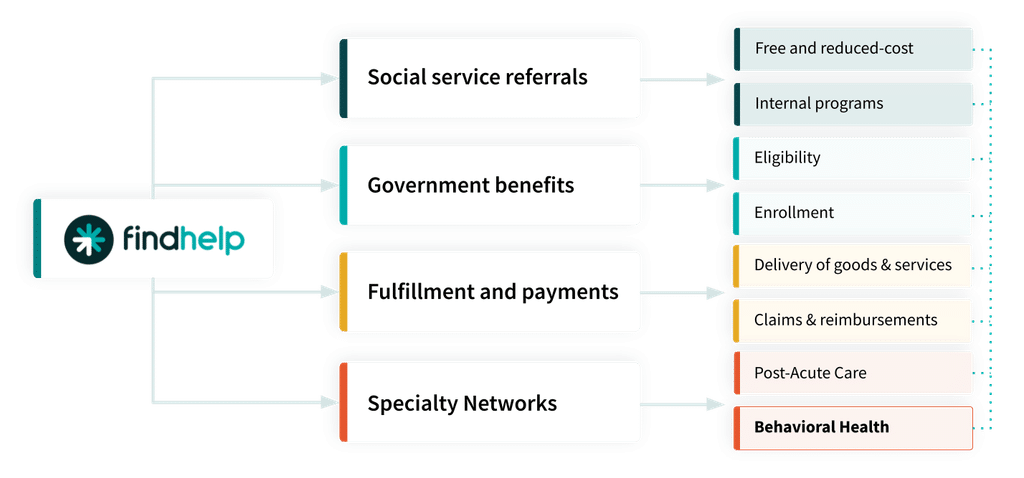
We’re changing that with the Findhelp Behavioral Health Network, a curated extension of our platform that unites behavioral health and social care into one search experience. By integrating specialized provider networks like MiResource and scheduling partners like SimplePractice directly alongside our social care network, care teams can find the right provider, verify accepted insurance, and connect people to whole person care.
Keep reading to learn:

Why connecting behavioral health and social care in one workflow closes critical care gaps.
How curated provider data solves the “ghost network” challenge and takes the maintenance burden off navigators.
Why moving beyond manual spreadsheets and workarounds gives organizations accurate, coverage-aware referrals.
The hidden cost of disconnected care
Behavioral health challenges don’t happen in a vacuum. In the United States, roughly 137 million people live in federally-designated mental health shortage areas, and of the more than 60 million individuals who experienced a mental illness last year, nearly half received no treatment.
At the same time, physical health, social circumstances, and mental well-being constantly influence one another.
“Roughly one in four [Medicare Advantage] enrollees had a mental illness diagnosis and at least one health-related social need. So people are not experiencing these challenges in isolation and they impact each other. Social vulnerability is associated with a higher prevalence of certain mental health and substance use disorders and in some cases even lower treatment rates, and conversely, untreated behavioral health can make it harder to maintain housing, employment or or even food security.”
Jaffer Traish
Chief Operating Officer at Findhelp
When care teams must look for mental health support in one system and social resources in another, the referral process stalls. Navigators lose context, patients fall through the cracks, and follow-up becomes nearly impossible.
“One of the most underlying needs that a human may have in today’s day and age, especially, is mental health assistance… [With Findhelp] they can also get connected to a food pantry, all these other types of things. So ‘one search, all services’ is expanding beyond that social care directory and starting to dip into other safe spaces such as behavioral health.”
Delaney Boldman
Business Solutions Architect at Findhelp
Through our Behavioral Health Network, we’re connecting care teams to a single front door for both clinical and social care—removing friction and supporting the whole person.
Moving from static lists to active supply
Finding an available behavioral health clinician is often framed as a shortage problem. While shortages do exist in certain regions, a more common issue is that provider lists are inaccurate and out of date.
Care managers and hospital social workers often rely on lists of ten or twelve local providers they know personally. When every worker in an area calls those same twelve clinicians, those practices quickly fill up. Meanwhile, hundreds of other qualified, licensed providers in the area have open appointments, but navigators struggle to reliably find them.
The broader directories offered by insurers and public programs often contain “ghost networks”—listings of providers who have retired, moved, stopped accepting a specific insurance plan, or closed their panels to new patients.
“There’s a term for this in the industry. It’s called a ghost network, meaning a network where there’s ghosts of listings still around which actually aren’t available to serve someone. So, we want to add transparency. We want to add accuracy and accountability to this open network where it’s not necessarily pay-to-play.”
Jaffer Traish
Chief Operating Officer at Findhelp
Building a working directory requires continuous curation. Over 70% of mental health providers in the U.S. operate solo private practices without administrative staff, billing teams, or referral coordinators. They do not have time to update multiple directories every week.
“People mostly know how to treat mental health care. That’s not necessarily the hard part. The hard part is actually identifying that care in the community that meets all of the logistical needs of that person.”
Mackenzie Drazan Cook
Co-Founder and CEO of MiResource
Why manual workarounds fall short
Many healthcare organizations have tried to solve this problem by managing provider lists internally. Teams pass around spreadsheets or save Word documents to shared drives.
While those efforts show dedication, manual lists create serious bottlenecks:
- Navigators and care coordinators spend valuable hours calling offices to ask if phone numbers have changed or if clinicians still accept certain Medicaid plans.
- Standard program listings often don’t include necessary information like clinical specialties, accepted insurance plans, or levels of care.
- A static document doesn’t have visibility into whether a therapist has an open appointment this week or a three-month waiting list.
Findhelp removes the busywork
Our Behavioral Health Network takes over network maintenance and bridges these gaps. Right in the Findhep platform, navigators and individuals can not only locate behavioral health providers, but also immediately access:
✔
Current availability
✔
Areas of focus & treatments
✔
Accepted insurance & cost
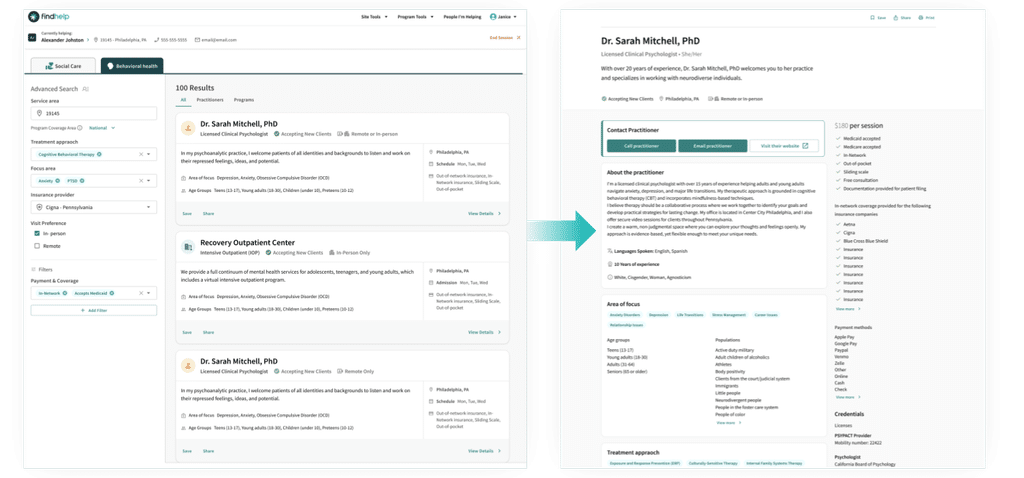
Tailored options for every behavioral health strategy
Whether you’re looking to drive awareness of your existing provider network, gain access to a fully maintained network, or a little of both, we’ve got you covered.
1
Access Existing Provider Networks
- Bring contracted providers into Findhelp so care teams can easily discover and use them.
- Ensure staff – or individuals – look to internal and contracted options first before referring out.
2
Access Expanded, Curated Networks
- Search a comprehensive network of verified therapists, counselors, structured treatment programs, and peer support groups.
- Access rich provider profiles with current intake criteria, accepted insurance, and real-time availability.
3
Combine Both Options to Fill Care Gaps
- Surface your existing network and supplement search results with curated network resources when internal gaps arise
- E.g., specialized youth therapy or substance use programs.
Matching the right person to the right care
Effective behavioral health matching goes far beyond booking an open slot on a calendar. A referral succeeds only when it aligns clinical needs, coverage, and personal preferences.
Navigators need to know:
?
Does this clinician treat specific conditions, such as obsessive-compulsive disorder, adolescent trauma, or substance use disorder?
?
Does the provider accept the patient’s specific plan (Medicaid Managed Care Organization, Medicare Advantage, or commercial)?
?
Does the practice offer language capabilities, cultural alignment, or sliding-scale fees for uninsured seekers?
With our Behavioral Health Network, navigators can filter by specific insurance plans, helping ensure patients are not referred to out-of-network care they cannot afford. Direct appointment scheduling will expand across network partners over time, but establishing reliable one-on-one counseling matches and coverage verification provides immediate protection against dead-end referrals.
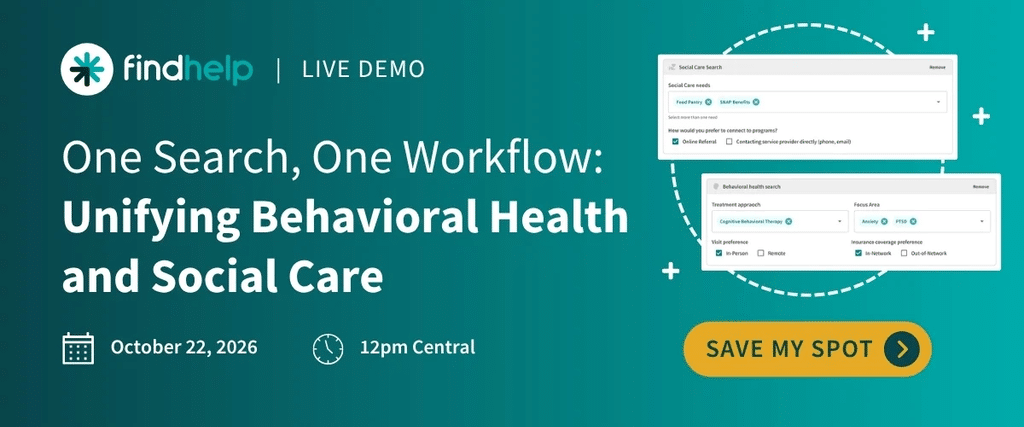
October 22, 2026 | See our Behavioral Health Network in action
To help care teams, health systems, and health plans explore how this network functions in practice, we are hosting a walkthrough and discussion on October 22:
- A live look at the dedicated Behavioral Health search experience within Findhelp.
- How coverage-aware matching filters providers by specific insurance plans and Medicaid MCOs.
- How organizations can digitize their existing local provider relationships while removing internal maintenance burdens.
- Ways that closed-loop referral tracking helps teams document outcomes and reduce avoidable hospital readmissions.
Register for the 30-minute demo to see how our Behavioral Health Network simplifies navigation across both social and clinical care.
Connecting people with care requires systems that work together. By pairing curated behavioral health resources with our nationwide social care platform, we are helping navigators move past static spreadsheets and dead-end phone calls. When helpers have access to accurate, coverage-aware data in a single search, they can guide individuals toward lasting support with dignity and ease.