













Digitizing the Social Safety Net to Work Better for Everyone
Written by Carla Nelson, Findhelp’s Sr. Director of Health Care and Public Policy. A version of this post was originally published in Healthcare Business Today.
More than 30% of Americans rely on public benefit programs such as Medicaid, Supplemental Nutrition Assistance Program (SNAP), Temporary Assistance for Needy Families (TANF), and Women, Infants, & Children (WIC). That is nearly one in three of our neighbors turning to the social safety net for support with healthcare, food, housing, and financial stability.
At the same time, policy shifts, evolving funding models, and scrutiny around public spending are reshaping the landscape. The pressure is clear. We must do more with what we have, and we must do it better.
The opportunity is just as clear. By pairing modern technology with strong community infrastructure, we can make the social safety net more efficient, more connected, and more human.
In this post, you’ll learn:

Why today’s social safety net can be difficult to navigate—and how fragmentation impacts both access and outcomes.
How digital tools and closed-loop referrals can connect healthcare and social care to improve efficiency and reduce costs.
What a modern, person-centered safety net looks like—and how it can expand access while preserving dignity.
When compassion becomes complicated
The American social safety net was born during the Great Depression to help families weather economic collapse. Over decades, it expanded into a web of federal and state agencies, national and local nonprofits, healthcare providers, and private funders. Each plays an important role. Yet too often, they operate in parallel rather than in partnership.
The result is a maze.
Many people must complete multiple applications across different systems to meet basic needs. Some programs still require in-person visits. For individuals juggling hourly jobs, caregiving responsibilities, or limited transportation, every extra step becomes a barrier. Complexity increases administrative costs and slows down delivery of care.
We also know that social drivers of health such as housing stability, food access, income, and community support account for roughly 80% of overall health outcomes. Healthcare leaders increasingly recognize this reality.
“The notion that our chronic disease burden is partly driven by our lifestyle, and in fact, there are interventions to mitigate that, I think that’s heartening. You’re seeing Medicaid start to pay for food to treat diabetes and hypertension, and we should amplify that as much as possible.”
Dr. Pritesh Gandhi
System Sr. Vice President, Chief Health Equity & Community Impact Officer at CommonSpirit Health

But insight without infrastructure falls short. When healthcare data and social care systems cannot communicate, care remains episodic and fragmented instead of coordinated and preventive.
Disconnects drive up costs
The United States invests trillions each year in healthcare and social services through public funding and private philanthropy. Yet outcomes do not consistently reflect that level of spending.
Enormous sums move through multiple layers before reaching the individual who needs help. Each handoff introduces friction. Technology can reduce that friction and route resources more directly to people and communities.
“Something like $1 trillion is going into the social safety net through private philanthropy, aside from traditional government funding. That’s an enormous amount of money. But those dollars go through three or four places before the service is delivered to an individual. Technology enables us to be more efficient and deliver those services directly to individuals.”
Jaffer Traish
Chief Operating Officer at Findhelp

Research underscores the potential. A study published in Population Health Management found that connecting Medicaid and Medicare Advantage members to social services can reduce healthcare costs by about 10 percent, or more than $2,400 per person annually. With more than 100 million Americans enrolled in those programs, the aggregate savings could be significant. Beyond dollars, better coordination means better health and greater stability for families.
Still, many referrals are managed through phone calls, spreadsheets, paper flyers, or sticky notes. Staff spend hours researching available resources and making manual connections. In one New York hospital, thousands of staff hours were dedicated solely to recommending community resources.
Digital systems can automate the search and referral process, freeing nurses, care navigators, and community organizations to focus on what matters most: meaningful human interaction. Efficiency and empathy are not opposites. When routine tasks are streamlined, people have more time to listen, support, and build trust.
Why digitization matters now
Digitizing the social safety net does not mean replacing people with technology: It means building infrastructure that helps people do their jobs more effectively and helps individuals access services with dignity.
An interoperable, technology enabled approach can:
- Reduce silos between healthcare and social services
- Integrate electronic health records with community referral platforms
- Enable closed loop referrals so providers know whether a connection resulted in services delivered
- Support data informed decisions about funding and program design
- Decrease administrative overhead
Closed-loop referral systems in particular allow organizations to track outcomes, understand what works, and allocate resources more strategically.
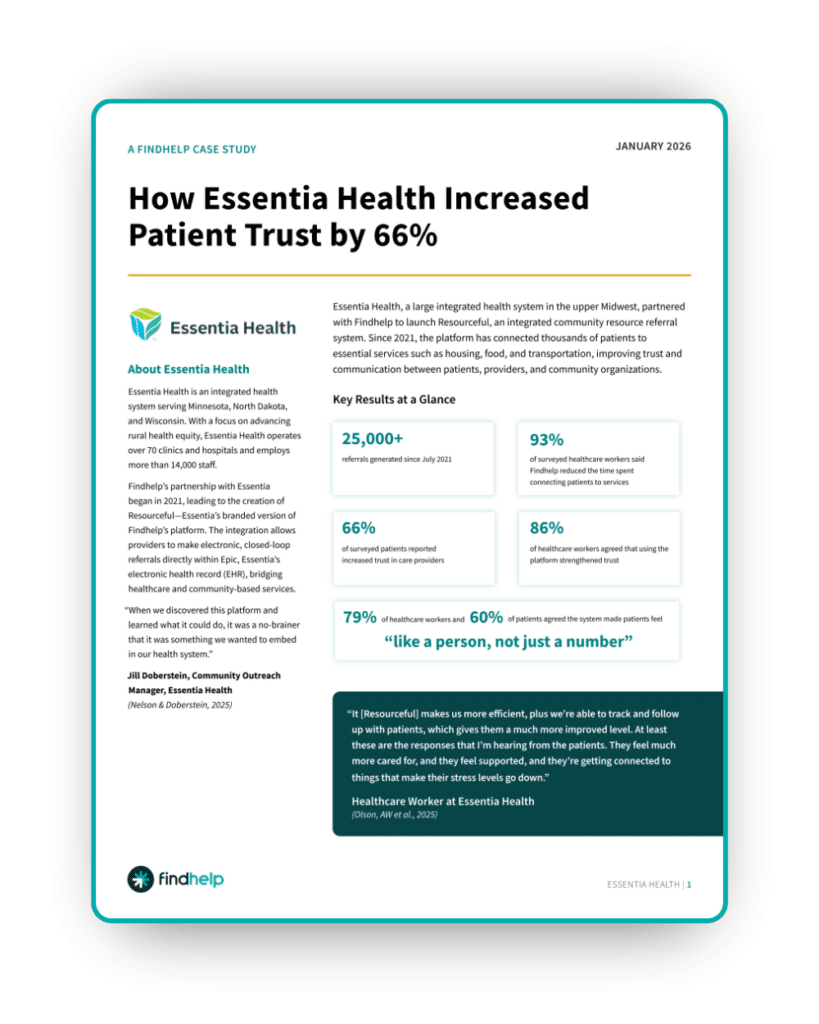
Emerging research shows these platforms improve trust and communication between individuals seeking help and the organizations serving them, as well as among cross sector partners.
When systems can talk to each other securely, we can measure impact more accurately and adapt services to meet real world needs.
Dignity through easier access
Most of us rely on digital tools every day. We transfer money in seconds. We order essentials online. We message across platforms without thinking twice.
Yet people seeking food assistance, rental support, or transportation often encounter analog systems that require repeated paperwork and in person visits. A modern, person centered digital experience can remove unnecessary hurdles while preserving privacy and security.
A tech-forward infrastructure can comply with HIPAA requirements, evolve alongside policy changes, and provide secure, user friendly access to services. Just as importantly, it can reduce the stigma that sometimes accompanies asking for help. When access is simple and private, individuals can focus on meeting their needs instead of navigating bureaucracy.
Building a stronger future
A digitally-connected social safety net benefits everyone. It supports families in times of need, strengthens local economies, and maximizes return on public and private investment. It also creates resilience, allowing communities to adapt as policies and funding environments shift.
By combining community expertise with scalable technology, we can build a system that is both efficient and compassionate. The goal is not merely modernization for its own sake. It is a coordinated, data informed, and human centered approach that ensures resources reach the people who need them most.