











NCQA | Scaling Social Care Through Local Partnerships
Health plans and community-based organizations (CBOs) play a critical role in addressing social care needs and advancing health outcomes. As policies change, local partnerships and teamwork between these groups is becoming more important for improving health outcomes.
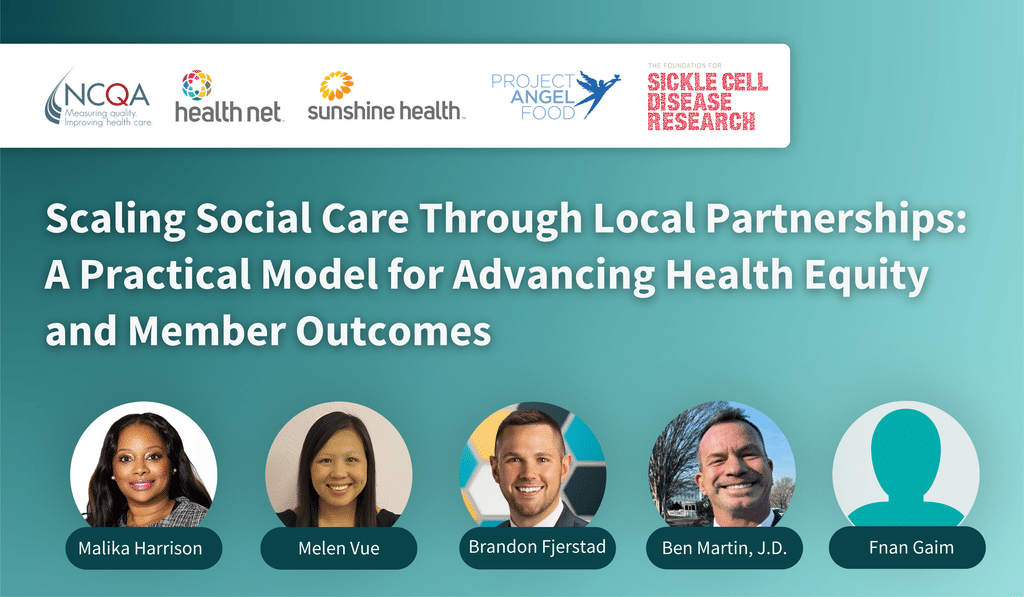
We were recently invited to join a National Committee for Quality Assurance (NCQA) webinar on this topic. During the discussion, leaders from Florida and California Centene plans and their CBO partners shared real examples of how their organizations work together to empower local autonomy, leverage cultural and community familiarity, and adapt programs to neighborhood-specific needs.
.
In this post, you’ll learn:

How to translate social care strategy into community-specific action.
Which social care data and feedback tools can help measure and improve programs.
Best practices for building trusted partnerships and effective data-sharing models with community partners.
Adapting to new healthcare policies
In California, the CalAIM initiative changed social care into a core part of population health strategy. Before CalAIM, many social programs were just small, short-term projects. The state framework allowed health plans to weave social care into their delivery systems.
According to the latest DHCS quarterly report, nearly 453,000 Medi-Cal members have received Enhanced Care Management services since the CalAIM initiative launched in 2022.
In Florida, state rules require health plans to screen members for social needs. Malika Harrison, Senior Director of Community Relations at Sunshine Health, noted that this mandate puts a greater focus on tracking and reporting, which helps organizations deliver better care for their members.
Whole Person Care is Working: New California Data Proves the Value of Addressing HSRN
“The goal is to do more than just to refer members to resources and services. It’s about really creating strong partnerships between health plans, providers, community organizations, and members.”
Melen Vue
Program Manager

Building deep relationships with community partners
Technology alone cannot fix social care challenges. Melen pointed out that “building a referral ecosystem requires more than just the technology”. It requires creating real connections and local partnerships among providers.
One way organizations do this is by forming a Trusted Network, where Findhelp customers and their community partners each have a seat at the table. Trusted Networks are tight groups that establish deep, long-term relationships. Customers who build these networks alongside us are better able to track referral outcomes.
“We pride ourselves on transparency, communication, and integrity, and I think that goes a long way toward building any relationship.”
Benjamin Martin
Senior Director of Programs and Strategy

Balancing data with human stories
Data helps teams track their success, but it is not the only important detail. Fnan Gaim, Referral Coordinator at the Foundation for Sickle Cell Disease Research, highlighted this balance. She explained, “…we recognize that the numbers only tell part of the story”. Completing a referral is just the start, and the true impact might not immediately appear in a spreadsheet. Her team looks at patient feedback to identify any barriers during the referral process.
Tracking closed-loop referrals is also a big piece of the puzzle—checking that the person actually received the support they needed. This step both ensures that people don’t fall through the cracks and improves teamwork between partners.
When asked what organizations should invest in first to build a good social care strategy, the panel agreed on one answer: people.
Continuing the journey together
We know that keeping a human touch is important when providing access to care. By building strong local partnerships, health plans and community organizations make a big difference for the people they serve. Watch the full webinar recording to hear more from these experts.
Interested in learning how your organization can leverage trusted partnerships to solve for social care needs? Connect with us.