



Going Beyond the Call: Ep. 5 of the ‘No Wrong Door’ Podcast

No Wrong Door is a podcast from Findhelp that explores how social care delivery is evolving to better support whole person care. Hosted by Findhelp VP of Marketing Amy Gordona, the series features conversations with social care experts, healthcare and government innovators, and Findhelp leaders who are shaping the future of access, coordination, and connected care.

Each episode offers an inside look at the systems, decisions, and ideas driving change—and what it takes to build a social safety net that works at scale.
'No Wrong Door' is a podcast from Findhelp exploring how social care delivery is evolving to better support whole-person care.

For millions of people across the U.S., dialing 211 is the first step toward finding help. But as community needs grow more complex, the role of 211 call centers is evolving—requiring better tools, deeper insights, and stronger connections across the social care ecosystem.

In Episode 5 of No Wrong Door, host Amy Gordona sits down with Findhelp’s Senior Director of Partnerships, Dallas Mudd, to explore how 211 is shifting from a referral-based model to a more coordinated, data-driven approach to care.

Why 211 call centers are evolving beyond information and referral

How fragmented systems limit visibility into outcomes

What becomes possible when data, technology, and community partners connect


Watch episode 5: “Going Beyond the Call”


Key themes from the conversation


211 call centers are the front door, but needs have grown more complex

211 has long served as a critical entry point to the social safety net, connecting people to essential resources like food, housing, and utility assistance. But the context surrounding those calls has changed.

People aren’t just looking for information—they’re navigating layered challenges, often in moments of crisis. That complexity requires more than a list of resources; it requires human connection and deeper support.

As needs become more interconnected, the systems supporting 211 must evolve to meet people where they are.

Sr. Director of Partnerships at Findhelp


Referrals alone aren’t enough—outcomes matter

Traditionally, 211 has been measured by volume: how many calls were answered or referrals made. But that only tells part of the story.

What happens after a referral—whether someone actually receives help—is increasingly what matters most to communities, funders, and policymakers.

Tracking outcomes, including when needs aren’t met, creates opportunities to improve coordination, refine referrals, and ultimately deliver better care.

VP of Marketing at Findhelp and host of ‘No Wrong Door’


Fragmentation creates inefficiency and missed opportunities

Behind the scenes, many 211 systems operate on fragmented, outdated technology. Even within a single state, multiple call centers may be duplicating efforts, maintaining separate databases, and working in isolation.

That fragmentation not only creates inefficiencies but also limits the ability to see patterns and respond to community needs at scale.

Bringing these systems together through shared infrastructure and integrated workflows can reduce duplication and unlock a clearer, more coordinated picture of need.

Sr. Director of Partnerships at Findhelp


Data turns 211 call centers into community insight engines

211 call centers don’t just connect people to resources—they also generate valuable insight into what communities need.

With better data and visibility, call centers can identify emerging gaps, inform funding decisions, and help direct resources where they’re needed most.

When paired with technology platforms like Findhelp, that data becomes even more powerful, revealing patterns across populations, geographies, and time.

Sr. Director of Partnerships at Findhelp


The future: coordinated, connected care

Looking ahead, the role of 211 call centers is expanding into something larger: a connected hub within a broader ecosystem of care.

With integrated technology, consent-driven data sharing, and stronger partnerships, call centers can move from isolated interactions to a continuous, coordinated experience.

By breaking down silos and working together, communities can build a more responsive, effective safety net—one that supports people not just in moments of crisis, but throughout their journey.

Sr. Director of Partnerships at Findhelp


What’s next for No Wrong Door?

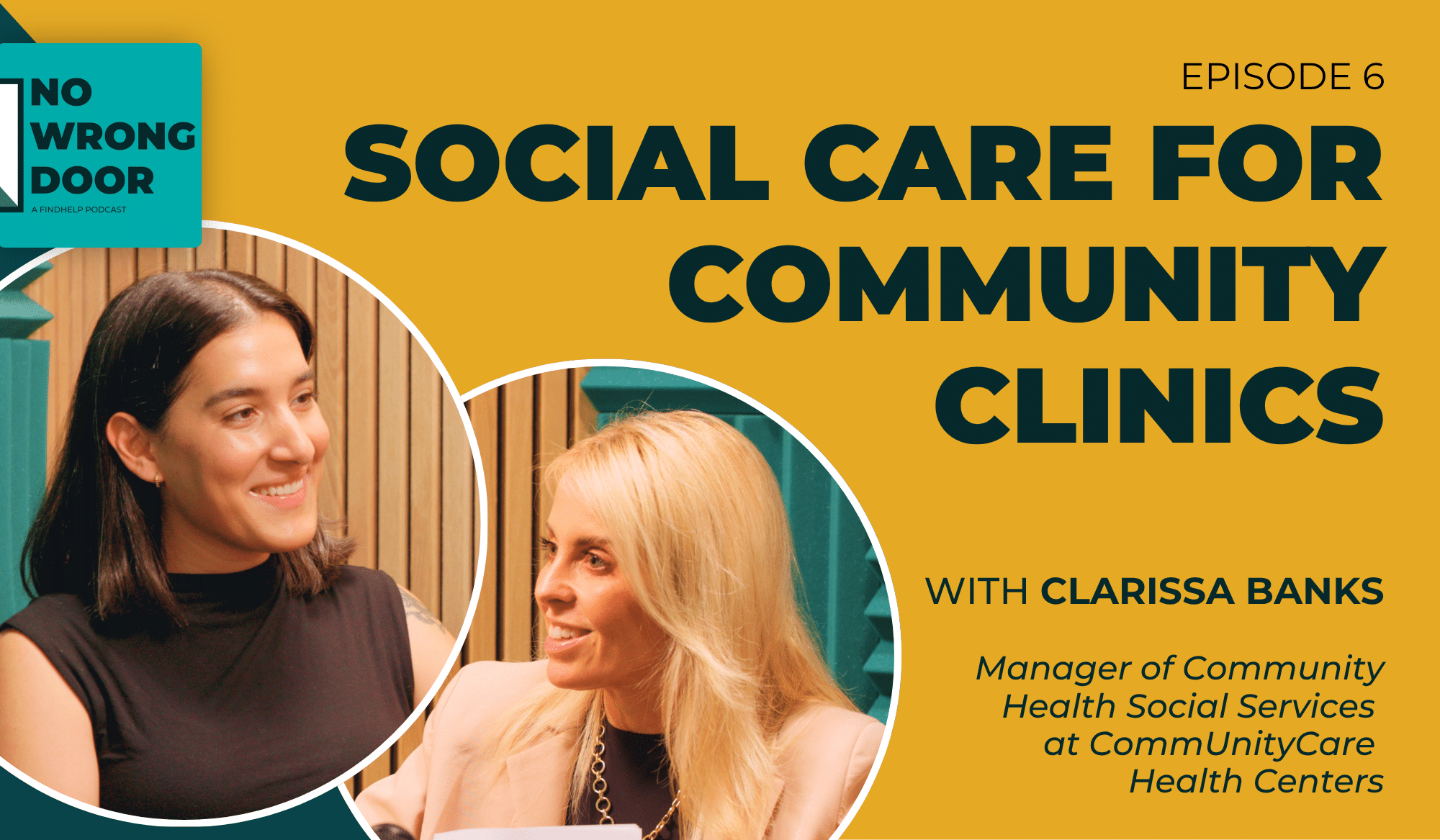
“Going Beyond the Call” is available now—Episode 6 will be released on April 15 and features Clarissa Banks, Manager of Community Health Social Services at CommUnityCare, talking about how they’ve successfully integrated clinical and social care workflows.

Subscribe to No Wrong Door wherever you listen to podcasts to be notified when new episodes drop:

'No Wrong Door' is a podcast from Findhelp exploring how social care delivery is evolving to better support whole-person care.

Modernizing Infrastructure for Medicaid Community Engagement Requirements

In Part 1 of this series we discussed the need for a connected infrastructure to meet Medicaid Community Engagement requirements. In Part 2 we defined the intelligent workflow required to operationalize those connections.

Now in Part 3, we look at the underlying architecture, arguing that meeting the 2027 mandate requires states to move past closed systems and embrace open APIs.

Findhelp policy expert Carla Nelson breaks down Medicaid community engagement requirements.

As the 2027 deadline for meeting Medicaid community engagement requirements approaches, states are making critical infrastructure decisions. For many Medicaid agencies, the logical starting point is their existing Eligibility and Enrollment (E&E) system. E&E systems are deeply embedded in state processes, and leveraging these existing investments is a practical way to approach a rapidly approaching federal deadline. However, Medicaid community engagement requirements introduce an operational challenge that E&E systems were not designed to solve.

Why traditional batch processing and closed Eligibility and Enrollment (E&E) systems are insufficient for the 2027 mandate and how they contribute to costly administrative bottlenecks.

Why it’s essential for authorized partners to access critical member data instantly, to ensure accurate enrollment and engagement tracking.

How implementing “Eligibility-at-Risk” flags can automate outreach to vulnerable members, reducing the high financial and clinical costs of coverage churn.


The path forward: Deep integration

New Medicaid community engagement mandates require:

Attempting to manage this decentralized, community-wide effort entirely within a closed E&E environment, or simply bolting a proprietary portal onto the outside of it, creates a bottleneck. When systems cannot communicate securely with the outside world, the burden of proof falls entirely on the member, and costs and administrative burden on government agencies inflate. 

To prevent this, states can use this mandate as a catalyst to modernize. In our recent policy recommendations to the Centers for Medicare & Medicaid Services (CMS), Findhelp outlined the critical interoperability standards required to turn siloed E&E systems into the engines of a connected ecosystem.

Here is why deep integration is the path forward.


The API imperative: An integration-first eligibility ecosystem

Historically, when states share member eligibility and enrollment rosters with MCOs or community partners, they have relied heavily on nightly or weekly batch files. But the rapid timelines of community engagement, including strict 30-day cure periods and 6-month renewal cycles, make manual data entry and batch processing financially unsustainable. A 48-hour delay in a batch file can easily translate into an inappropriate termination, followed by a costly appeals process that stresses limited state agency resources.

To solve this, E&E systems must be able to securely communicate in real time.

Findhelp has formally recommended that CMS enforce Conditions for Enhanced Funding (CEF). These federal rules dictate the standards states must meet to receive extra federal matching dollars for their Medicaid technology.

Under this authority, we recommend that CMS mandate State E&E systems to open up secure, real-time data channels (technically known as “Pull APIs”).

Medicaid community engagement requirements need Pull APIs to facilitate secure, real-time data channels.

Rather than waiting days for an outdated batch file, these real-time connections allow authorized partners to securely request and retrieve a member’s exact status the very moment they are trying to help them. These channels must allow entities, including MCOs, health systems, and integrated platforms like Findhelp, to retrieve critical data, including:

By exposing these APIs securely to authorized partners, states allow the broader ecosystem to shoulder the administrative workload, ensuring that federal system investments deliver lasting public value.


Pushing the signal: “Eligibility-at-Risk” flags

When state caseworkers have to manually identify and reach out to at-risk members, administrative costs skyrocket. APIs allow partners to pull information, but a modernized, cost-efficient system must also be able to proactively push alerts.

State E&E systems should automatically generate and transmit these flags when a member is approaching their redetermination deadline or has a demonstrated compliance deficit (e.g., fewer than 80 hours logged with less than 30 days remaining in the period).

Crucially, these flags must be routed to where the workforce already exists: Health Information Exchanges (HIEs), MCO care management platforms, and community workflow networks like Findhelp.


Avoiding the high cost of churn

Coverage loss is an expensive clinical event, not merely an administrative one.

  1. Administrative cost of processing the termination and the potential re-enrollment (churn)

  2. Downstream medical costs generated when that member’s care is disrupted
Member churn due to missed Medicaid community engagement requirements leads to states paying twice.

Routing eligibility risk signals through interoperable platforms brings the relevant data directly to the providers and community health workers who are already engaging with the patient. It allows a navigator to see an “Eligibility-at-Risk” flag during a routine clinical follow-up and immediately help the member upload an exemption document or find a qualifying volunteer program.

This closes the gap before the state has to process a termination.


Conclusion: Modernization, not just compliance

Findhelp is built on the premise that you cannot solve a systemic, community-wide challenge with a siloed tool.

By demanding open APIs and proactive risk flags, states can transform their existing E&E investments into the foundation of a dynamic, supportive ecosystem. This approach reduces costs, protects members, and turns a complex federal mandate into an opportunity for true modernization.


What’s next?

If open APIs and deep integration are the architectural goals, what exactly does the data look like when it flows between these systems?

In Part 4, we will break down the Data Model, exploring the specific data elements and standards required to power this interoperable future.

New York Social Care Summit: Highlights from the Empire State

New York’s social care leaders came together for Findhelp’s New York Social Care Summit with a shared ambition: to transform a complex, fragmented safety net into a connected, data-driven ecosystem that works for everyone.

Across healthcare systems, community-based organizations (CBOs), policymakers, and technology leaders, one theme stood out:

Social care in New York isn’t just evolving—it’s scaling.

New York is scaling social care through policy and technology, with the 1115 Waiver driving standardized, reimbursable, and connected care.

Benefits access is one of the most powerful levers to reduce poverty, but only if enrollment is simple, accessible, and trusted.

Cross-sector networks are turning pilots into population-level impact, building toward a future where social care is standard care.

A special thank you to everyone who joined us and to our fantastic speakers for sharing their insight, experiences, and vision.


Highlights from the 2026 New York Social Care Summit

This year’s Summit featured 105 participants representing government agencies, healthcare providers, community organizations, and more:


Below are some of the key themes and takeaways from a day of learning and sharing.


Building the infrastructure for a connected future

The Summit opened with a clear vision: a fully integrated social care continuum that connects people to the services they need—quickly, accurately, and with dignity.

From eligibility and enrollment to referrals, service delivery, and reimbursement, Findhelp is building end-to-end coordination powered by shared data and interoperable systems.

VP, National Accounts at Findhelp

With the state’s 1115 Waiver reshaping how social care is funded and delivered, organizations are aligning around standardized needs assessments, codified data, and referrals to eligible services—ensuring people are connected to programs they can actually access.

At the same time, new tools are reducing friction for both navigators and community partners, turning what was once a maze into something closer to a guided pathway.


Unlocking the power of benefits access

A fireside chat with leaders from Findhelp and the Robin Hood Foundation explored one of the most immediate ways to drive impact: helping people access the benefits they’re already eligible for.

The stakes are high.

Chief Program & Impact Officer at Robin Hood Foundation

But accessing those benefits has historically been anything but simple. Complex applications, documentation requirements, and systemic barriers have left billions of dollars on the table—and millions without support.

Today, that’s changing.

Head of Uno Health at Findhelp

New innovations are streamlining eligibility, simplifying applications, and enabling both self-service and navigator-led enrollment.

Just as importantly, leaders emphasized that benefits access isn’t just about short-term relief—it’s a long-term investment in mobility, health, and economic stability.


From pilots to population-level impact

Across New York, organizations are moving beyond small-scale pilots and building networks designed to serve entire populations.

Leaders from NYC Health + Hospitals, SOMOS Community Care, and Value Network of Western New York shared how they are scaling social care through governance, partnership, and technology.

A common lesson: success starts with meeting partners where they are.

Assistant Director, Social Medicine at NYC Health + Hospitals

From onboarding CBOs still using spreadsheets to integrating with complex health system workflows, flexibility has been critical. At the same time, organizations are investing in training, communication, and shared decision-making to build lasting buy-in.

Director, Project Management at SOMOS Community Care

As these networks grow, so does their ability to demonstrate impact—using data to understand needs, improve outcomes, and inform future investment.


Designing Networks That Work in the Real World

Implementation is where strategy meets reality, and where many organizations encounter their biggest challenges.

Sessions focused on navigation and workflow design revealed a simple but powerful truth: technology only works when it works for people. That means minimizing administrative burden, integrating into existing systems, and building trust at every step.

It also means rethinking how we engage individuals—especially when addressing sensitive needs like food insecurity or housing instability.

Chief Financial Officer, Forward Leading Independent Physician Association (FLIPA)

Organizations are investing in trauma-informed care, motivational interviewing, and community-based navigation models to ensure people feel supported—not scrutinized.

And increasingly, they’re building systems that empower individuals to navigate on their own.


Closing the loop to prove what works

At the heart of New York’s approach is a focus on accountability and outcomes.

Closed-loop referrals—where providers can see whether someone actually received services—are becoming the standard, not the exception.

Social Care Network IT Field Operations at SOMOS Community Care

This level of visibility is critical not only for care coordination, but for demonstrating the value of social care interventions.

Time and again, speakers emphasized that data—paired with real stories—will be key to sustaining and expanding this work.

Chief Financial Officer, Forward Leading Independent Physician Association (FLIPA)


Modernizing the safety net for what comes next

As policy changes, economic pressures, and new requirements reshape the landscape, New York is preparing for what’s ahead. From Medicaid redetermination to work requirements, the need for streamlined, scalable solutions has never been greater.

Findhelp’s evolving platform is designed to meet that moment—integrating eligibility, navigation, referrals, and compliance into a single, connected experience. Looking forward, innovations like personalized search, AI-powered navigation, and expanded behavioral health networks will continue to push the system toward something more proactive, accessible, and human-centered.

With strong leadership, innovative tools, and a growing network of committed partners, New York is helping define what the future of social care can look like—not just in one state, but across the country.

And this is only the beginning.

Read Carla Nelson's social care data paper.

Sr. Director of Health Care & Public Policy at Findhelp

Caring for our neighbors

We’re grateful to the City Harvest Food Rescue Center—a local nonprofit that rescues perfectly good, nutritious food that would otherwise go to waste.

They stopped by the Summit to pick up the extra food and beverages to share for free with New Yorkers experiencing hunger.


Beyond the Summit: Our work in New York

While the Summit provided a rich day of insight and connection, the real work continues — in homes, clinics, schools, and community hubs across New York.

Some of the numbers that show the scale and momentum:


As of March 2026, we partner with more than 44 customers throughout the state to connect their patients, members, students, constituents, and clients to local resources. Our data and analytic tools can identify gaps in services and provide actionable insights to inform strategy and public policy. 

Growth in searches in New York on Findhelp platforms, Q1 2021 through Q4 2025


Together, with our New York partners, we’re building toward a future where social care is not an afterthought — but a foundational part of how health, housing, and human services work together.


Let’s keep the conversation going

If you’re interested in how Findhelp can support your work in New York — whether you’re a health system, community-based organization, payer, or state agency — we’d love to chat.

Breaking Down Data Silos: Ep. 4 of the ‘No Wrong Door’ Podcast

No Wrong Door is a podcast from Findhelp that explores how social care delivery is evolving to better support whole person care. Hosted by Findhelp VP of Marketing Amy Gordona, the series features conversations with social care experts, healthcare and government innovators, and Findhelp leaders who are shaping the future of access, coordination, and connected care.

Each episode offers an inside look at the systems, decisions, and ideas driving change—and what it takes to build a social safety net that works at scale.

'No Wrong Door' is a podcast from Findhelp exploring how social care delivery is evolving to better support whole-person care.

Connecting people to the right support at the right time is at the heart of social care. But behind every successful connection is something less visible and far more complex: data.

In Episode 4 of the No Wrong Door podcast, host Amy Gordona speaks with Findhelp Chief Operating Officer Jaffer Traish about why social care data exchange is essential to building a functional digital safety net. From interoperability and data standards to privacy and policy, their conversation explores what it will take to coordinate care across systems and ensure people don’t fall through the cracks.

How social care data often lives across many disconnected systems, limiting visibility into whether services actually happen.

Why interoperability, standards, and collaboration are essential to building a shared infrastructure for social care.

How consent and privacy must remain central, ensuring individuals control how their information is shared.


Watch episode 4: “Breaking Down Data Silos”


Key themes from the conversation

What is social care data exchange? Social care data exchange is the secure, consent-driven sharing of information about a person’s needs, referrals, and outcomes across healthcare providers, government agencies, and community organizations to improve care coordination and outcomes.


Fragmentation makes coordination harder

Why fragmented social care data leads to gaps in care

Information about a person’s needs, referrals, and outcomes is spread across health systems, government agencies, and community-based organizations, each operating on different technology platforms.

That fragmentation can make it difficult for providers to coordinate care or understand whether someone ultimately received the support they were referred to.

Without a shared view of a person’s needs and history, people risk repeating their story across systems or missing services entirely.

Building a digital safety net requires systems that can facilitate social care data exchange responsibly to create a clearer picture of the services people receive.

VP of Marketing at Findhelp and Host of ‘No Wrong Door


Social care is following healthcare’s path to digitization

Healthcare went through its own transformation decades ago as medical records moved from paper files to digital systems capable of sharing information across providers.

Social care is now entering a similar transition. The sector is beginning to build the infrastructure necessary to move information between organizations so providers can coordinate support more effectively.

Lessons from healthcare’s digitization can help guide this process, including the importance of interoperability standards, shared governance, and cross-sector collaboration.

COO at Findhelp


Standards are essential for meaningful data exchange

The role of data standards in social care interoperability

One challenge facing the social care ecosystem is the lack of standardized data. Even basic screening questions can vary widely across organizations.

Without common definitions and coding systems, data becomes difficult to interpret or share across platforms.

Initiatives like the Gravity Project are working to establish shared standards and taxonomies for social care data so organizations can exchange information with greater clarity and consistency.

COO at Findhelp


Consent and dignity must guide data sharing

What is consent-driven data sharing in social care?

While data exchange is critical for coordination, protecting individuals’ privacy and dignity remains paramount. Social care data can include deeply personal information about financial hardship, housing instability, or behavioral health.

Consent-driven data sharing frameworks can help strike the balance between improving coordination and ensuring individuals retain agency over their information.

COO at Findhelp


Why the future of social care data exchange is promising

Across the country, health systems, community organizations, and state governments are beginning to evaluate the real-world impact of social care investments.

By measuring outcomes and documenting the lives touched through coordinated services, these leaders are building the case for long-term sustainability.

That focus on measurable results could help ensure that social care infrastructure continues to grow and mature in the years ahead.

COO at Findhelp


What’s next for No Wrong Door?

“Breaking Down Data Silos” is available now—Episode 5 will be released on April 1 and features Dallas Mudd, Findhelp’s Sr. Director of Partnerships, talking about our new Call Center functionality.

Subscribe to No Wrong Door wherever you listen to podcasts to be notified when new episodes drop:

'No Wrong Door' is a podcast from Findhelp exploring how social care delivery is evolving to better support whole-person care.

New! Call Center Functionality: Transform Navigator Workflows

For teams supporting people by phone—whether through intake, outreach, or enrollment—manual processes, disconnected systems, and double entry slow down every conversation. Navigators spend valuable time toggling between platforms instead of focusing on what matters: connecting callers to the right services quickly and efficiently.

We designed our new Call Center workflow to change that. It streamlines telephonic support by integrating intake, service search, sharing, and follow-up directly into the Findhelp platform—so navigators can manage the entire call from start to finish without switching systems.

Our new Call Center workflow brings intake, service search, sharing, and follow-up into one unified experience.

You can register for our webinar on March 24.

Your organization can join the Early Adopter Program to shape the product and improve how your team supports callers.


Built for navigators, not just callers

The Call Center functionality focuses on improving the navigator experience:

Introducing Findhelp's new Call Center workflows.

We built this workflow for teams that handle high volumes of calls, whether or not they operate a formal call center. It’s designed to reduce administrative burden, improve workflow efficiency, and make phone-based support measurable and repeatable.


Join the Call Center Early Adopter Program

We’re inviting existing Findhelp customers who field calls as part of their operations to participate in our Early Adopter Program. This is your chance to gain early access to the Call Center workflow and help shape its development to better meet navigator needs.

What participants get

  • Early Access: Use the Call Center workflow before general availability.
  • Dedicated Support: Onboarding, workflow design sessions, and live training.
  • Direct Influence: Provide feedback and shape final features through structured sessions with Findhelp’s Product team.
  • Thought Leadership Opportunities: Participate in webinars, Connect Summit sessions, and case studies.
Introducing Findhelp's new Call Center workflows.

What we ask

This is a hands-on partnership. We’re focused on improving navigator efficiency, operational insights, and real-world usage metrics.


See the Call Center workflow in action

Learn more about how Findhelp can streamline navigator operations from our recent webinar, where we demonstrated the Call Center workflow, explained the Early Adopter Program, and answered questions about participation.


Ready to get started? Apply to participate

Spots in the Early Adopter Program are limited to ensure hands-on onboarding and high-touch support. If your team supports people by phone and wants to make every call more efficient, measurable, and manageable, this is your opportunity to lead the future of integrated phone-based navigation.

Join a select group of early adopters helping build integrated phone-based navigation tools—designed to streamline intake, reduce manual data entry, and make every conversation measurable.

North Carolina Social Care Summit: Highlights from the Tar Heel State

North Carolina social care leaders gathered for Findhelp’s State Summit with a shared purpose: strengthening the connections between healthcare systems, community organizations, and the technology that helps people access support. Across the state, organizations are working to bridge gaps between clinical care and the social factors that shape health outcomes. At the Summit, healthcare leaders, nonprofit partners, and community advocates explored how stronger partnerships, better data, and coordinated workflows can transform how people receive help.

The day’s theme? Building a connected safety net requires collaboration across sectors.

Intentional partnerships allow healthcare and community partners to coordinate care and share information more effectively.

Investment in community partnerships is key, with health systems funding, training, and supporting CBOs to strengthen local networks.

New tools are enabling end-to-end social care, helping organizations meet state CalAIM requirements.

A special thank you to everyone who joined us and to our fantastic speakers for sharing their insight, experiences, and vision.


Highlights from the 2026 North Carolina Social Care Summit

This year’s Summit featured 65 participants representing government agencies, healthcare providers, community organizations, and more:


Below are some of the key themes and takeaways from a day of learning and sharing.


Scaling social health through data and partnerships

Advocate Health opened the summit by sharing how they’re embedding social health into clinical care across their multi-state health system. By integrating social drivers of health (SDoH) screening across inpatient care, emergency departments, primary care, pediatrics, and women’s health services, Advocate has built a system that identifies needs early and connects patients to support.

In 2025 alone, the organization screened more than 1.9 million patients, reaching its goal of screening 55% of patients across the enterprise. Roughly 13% screened positive for at least one need, with food insecurity emerging as the most common challenge.

Cherelle Rozie from Advocate Health spoke at Findhelp's North Carolina Social Care Summit in 2026.

Associate VP, Social Health & Community Health Workers at Advocate Health

Patients who request help are directed to community resources through Findhelp, with links delivered through after-visit summaries and text messages. Community health workers and care teams then follow up to ensure patients receive support. Advocate’s strategy has also focused on building sustainable partnerships with community organizations. By consolidating referral workflows through Epic and Findhelp, the system has dramatically increased engagement across its network.

The results speak for themselves:

Advocate is also using these insights to guide investments in the community. In 2025, the health system committed $1 million toward food security initiatives, using Findhelp referral data to identify where resources could have the greatest impact.

Cherelle Rozie from Advocate Health spoke at Findhelp's North Carolina Social Care Summit in 2026.


A new vision for North Carolina social care

Findhelp’s COO, Jaffer Traish, outlined how social care infrastructure is evolving nationally and across North Carolina. Trusted Networks across the state are continuing to expand, with health systems such as Advocate Health, Novant Health, Cone Health, and Duke Health helping build coordinated ecosystems that connect healthcare providers, nonprofits, and community organizations.

COO of Findhelp

With Findhelp, organizations are moving from fragmented systems toward a unified model where needs assessments, referrals, eligibility checks, and service delivery can all happen within a single coordinated workflow. This model is helping partners navigate changing policy landscapes and streamline the delivery of services.


Community organizations driving local impact

A panel featuring leaders from Endless Opportunities, Hearts and Hands Food Pantry, and Sunnyside Ministries showcased how community-based organizations (CBOs) are using Findhelp to strengthen their operations and better serve their communities.

For these organizations, Findhelp’s platform has become much more than a referral tool. It serves as a system of record, a reporting engine for grant funding, and a way to understand emerging community needs.

Lashonda Houston spoke at Findhelp's North Carolina Social Care Summit in 2026.

Founder & Executive Director of Endless Opportunities

Organizations are using search trends, referral data, and reporting tools to inform programming decisions and identify service gaps. For Hearts + Hands Food Pantry, the ability to track referral volume and map community needs has been particularly valuable. Panelists also emphasized the importance of having a shared statewide platform that allows organizations to connect across sectors.

Kenya Jackson spoke at Findhelp's North Carolina Social Care Summit in 2026.

Co-Founder & President of Hearts and Hands Food Pantry

Speakers at Findhelp's North Carolina Social Care Summit in 2026.


Building Trusted Networks that close the loop

Cone Health shared its journey from fragmented referral systems to a coordinated, Trusted Network powered by Findhelp. Before adopting the platform, referrals were often manual and inconsistent, leaving clinicians unsure whether patients ever received help. “The first approach looked strong on paper but failed in practice,” said Emerson Frizzell, Director of Accountable Communities at Cone Health.

By engaging clinicians and community organizations directly in the implementation process, Cone built a network based on real referral patterns and trusted partnerships. The results have been transformative.

More than 2,000 Cone Health staff members now actively use the platform, and referrals are consistently tracked and monitored.

Emerson Frizzell from Cone Health spoke at Findhelp's North Carolina Social Care Summit in 2026.

Director of Accountable Communities at Cone Health

The health system has also invested in strengthening its community partners through a CBO Capacity Building Series, offering leadership training, peer collaboration opportunities, and LinkedIn Learning access to nonprofit partners.


Community engagement as infrastructure

Technology alone cannot activate a social care ecosystem. That was the central message from Austen Williams of The Medi. The organization focuses on strengthening community engagement and helping organizations activate their Findhelp networks through outreach, training, and partnership building.

The Medi’s work demonstrates how intentional engagement can dramatically increase community participation.

Austen Williams from The Medi spoke at Findhelp's North Carolina Social Care Summit in 2026.

Executive Director at The Medi

Across its community resource center platforms, user engagement has grown from 715 users in 2022 to more than 17,000 users in 2025, driven by partnerships with trusted local organizations. By embedding community engagement into operational strategy, organizations can turn technology platforms into thriving ecosystems of care.

Austen Williams from The Medi spoke at Findhelp's North Carolina Social Care Summit in 2026.


Powering the next generation of social care

The summit concluded with a look at Findhelp’s evolving platform and the future of social care infrastructure. New capabilities are helping organizations streamline eligibility checks, automate enrollment for government benefits, and expand referral networks to include behavioral health providers and post-acute care services.

Our long-term vision is simple but ambitious:

“One search, all services.”

By integrating benefits enrollment, referral workflows, and community services into a unified system, Findhelp aims to create a comprehensive social care record that supports coordinated care across sectors.

Cherelle Rozie | Associate VP, Social Health & Community Health Workers at Advocate Health


Beyond the Summit: Our work in North Carolina

While the Summit provided a rich day of insight and connection, the real work continues — in homes, clinics, schools, and community hubs across North Carolina.

Some of the numbers that show the scale and momentum:


As of March 2026, we partner with more than 16 customers throughout the state to connect their patients, members, students, constituents, and clients to local resources. Our data and analytic tools can identify gaps in services and provide actionable insights to inform strategy and public policy. 

Growth in searches in North Carolina on Findhelp platforms, Q1 2021 through Q4 2025


Together, with our North Carolina partners, we’re building toward a future where social care is not an afterthought — but a foundational part of how health, housing, and human services work together.


Let’s keep the conversation going

North Carolina’s Social Care Summit highlighted the progress being made across the state to build a more connected and effective safety net.

Healthcare providers, nonprofits, policymakers, and technology partners are working together to ensure that individuals don’t just receive referrals—they receive real support. As networks continue to grow and partnerships deepen, North Carolina is helping demonstrate what the future of integrated social care can look like.

If you’re interested in how Findhelp can support your work in North Carolina — whether you’re a health system, community-based organization, payer, or state agency — we’d love to chat.

Strengthening Rural Health Systems: Ep. 3 of the ‘No Wrong Door’ Podcast

No Wrong Door is a podcast from Findhelp that explores how social care delivery is evolving to better support whole person care. Hosted by Findhelp VP of Marketing Amy Gordona, the series features conversations with social care experts, healthcare and government innovators, and Findhelp leaders who are shaping the future of access, coordination, and connected care.

Each episode offers an inside look at the systems, decisions, and ideas driving change—and what it takes to build a social safety net that works at scale.

'No Wrong Door' is a podcast from Findhelp exploring how social care delivery is evolving to better support whole-person care.

Transforming rural health means fixing the gaps beneath it.

Rural healthcare conversations often center on provider shortages and hospital closures. But in Episode 3 of No Wrong Door, host Amy Gordona sits down with Carla Nelson, Findhelp’s Senior Director of Healthcare and Public Policy, to explore a deeper truth: you cannot improve rural health without addressing the fragmented social systems that shape it.

Why rural health challenges go far beyond clinical capacity

How funding, infrastructure, and data shape what’s possible in rural communities

What it takes to move from disconnected efforts to coordinated, whole person care


Watch episode 3: “Strengthening Rural Health Systems”


Key themes from the conversation

Improving rural health is not about one program or one funding stream. It’s about aligning policy, technology, and community systems so that providers, patients, and communities are not navigating complexity alone.

It’s not just about how far you have to drive

It is easy to think of rural healthcare as a geography problem. Fewer hospitals. Fewer specialists. Longer drives. But the challenges run deeper. Transportation, housing stability, food access, and benefits enrollment are not peripheral issues. They are structural conditions that influence outcomes every day.

When those needs are managed through disconnected systems, even strong clinical care cannot close the gap.

Carla adds that small breakdowns can carry enormous consequences in rural settings, where help may be hours away and time-sensitive interventions are harder to coordinate.

VP of Marketing at Findhelp and Host of ‘No Wrong Door


Funding creates opportunity, but what’s needed is sustainability

The newly established Rural Health Transformation Fund brings $50 billion in federal investment to rural communities. States are moving quickly to modernize facilities, improve chronic disease management, and expand telehealth capacity.

But funding alone is not the finish line. The true test is whether investments create systems that last after the dollars are spent.

The aim is not just temporary relief, but durable infrastructure that strengthens care delivery for the long term.

Sr. Director of Healthcare and Public Policy at Findhelp


Infrastructure and data shape care plans

Technology in rural health is not just about newer systems. It is about interoperability, data flow, and the ability to connect social and clinical information in real time.

When providers understand what is happening in a patient’s life outside the clinic walls, care changes.

Access to social data allows providers to design realistic care plans that account for food access, housing stability, transportation, and other core conditions of health.

Sr. Director of Healthcare and Public Policy at Findhelp


Capacity, burnout, and the human toll

Rural providers often wear many hats. They are clinicians, community anchors, and trusted advisors. In small communities, they may also be neighbors and friends. That closeness brings trust, but also pressure.

Limited funding, workforce shortages, and outdated systems compound the burden.

Modern infrastructure, better tools, and coordinated systems can reduce administrative strain and help restore capacity and morale.

Sr. Director of Healthcare and Public Policy at Findhelp


What’s next for No Wrong Door?

“Strengthening Rural Health Systems” is available now—Episode 4 will be released on March 18 and features Jaffer Traish, Findhelp’s COO, talking about social care consent, data exchange, and where we go from here.

Subscribe to No Wrong Door wherever you listen to podcasts to be notified when new episodes drop:

'No Wrong Door' is a podcast from Findhelp exploring how social care delivery is evolving to better support whole-person care.

Southern California Social Care Summit: Highlights from the Golden State

Southern California’s social care leaders gathered with a shared goal: to build a more connected, coordinated, and compassionate system of care. Healthcare providers, health plans, community-based organizations (CBOs), and regional collaboratives came together in Long Beach to explore how technology, partnerships, and community leadership can transform how people access support.

Throughout the day, one message rang clear: social care works best when it works together.

Intentional partnerships allow healthcare and community partners to coordinate care and share information more effectively.

Investment in community partnerships is key, with health systems funding, training, and supporting CBOs to strengthen local networks.

New tools are enabling end-to-end social care, helping organizations meet state CalAIM requirements.

A special thank you to everyone who joined us and to our fantastic speakers for sharing their insight, experiences, and vision. The Summit reminded us that while policies and systems are complex, the mission is simple: connecting people to the help they need.


Highlights from the 2026 Southern California Social Care Summit

This year’s Summit featured 110 participants representing government agencies, healthcare providers, community organizations, and more:

Attendees at Findhelp's Southern California Social Care Summit.


Below are some of the key themes and takeaways from a day of learning and sharing.


Building toward end-to-end social care

Findhelp opened the Southern California Social Care Summit by sharing its vision for the social care continuum—and where the platform is headed next.

New capabilities, including post-acute care coordination and expanded behavioral health networks, are designed to support the full arc of a person’s journey, from identifying needs to delivering services and tracking outcomes.

VP of National Accounts, Findhelp 

With programs like CalAIM reshaping California’s healthcare landscape, Findhelp is continuing to invest in tools that simplify reimbursement, automate workflows, and codify needs assessments using standardized clinical codes. These innovations help ensure providers and community partners can work more efficiently while meeting new requirements for closed-loop referrals.

Just as importantly, the platform is helping individuals navigate uncertainty—especially amid Medicaid redetermination challenges—by connecting them not only to healthcare services, but also to job opportunities, volunteer roles, and other pathways to stability.

Attendees at Findhelp's Southern California Social Care Summit.


From partnership to impact: Coalition networks in action

A panel featuring leaders from Inland Empire Health Plan, Inland SoCal United Way, and the Inland Empire Health Information Organization highlighted the power of regional coalitions like ConnectIE. Their shared goal was simple but ambitious: create a coordinated network where healthcare providers, social services, and community organizations could work from a shared understanding of each person’s needs.

Program Director, Inland Empire Health Information Organization 

Coalitions enable organizations to securely share consented information, including referrals, assessments, and social risk factors. This longitudinal view helps reduce duplication and ensures individuals don’t have to repeat their stories every time they seek help.

But building trust took time.

Director of Health Equity Operations, Inland Empire Health Plan

Today, the Inland Empire coalition network supports thousands of individuals across Riverside and San Bernardino counties, improving coordination between health plans, 211 services, and CBOs.


Activating community networks through investment and engagement

Cedars-Sinai shared how they built their Community Connect Program, a Trusted Network designed to close social care gaps and strengthen partnerships with community organizations.

Before Findhelp, their approach was fragmented. Screening varied across teams, relationships with CBOs were siloed, and it was difficult to track outcomes. Creating a centralized network—and dedicating staff to maintain community partnerships—changed everything.

Director of Community Health Programs at Cedars-Sinai

In partnership with Findhelp, Cedars-Sinai established a multi-year grantmaking pilot that provided funding to CBOs addressing housing instability, substance use disorder, and mental health needs. The pilot ultimately helped secure a $400,000 annual budget to sustain and expand the work.

Attendees at Findhelp's Southern California Social Care Summit.


Turning technology into real-world impact

Health systems across Southern California are integrating social care more deeply into clinical workflows. UCI Health, which recently launched Findhelp across dozens of clinics, focused on ensuring staff and community partners were equipped to use the platform effectively.

Their approach prioritized quality over quantity—ensuring referrals were meaningful and partners were prepared to respond.

Director, Office of Community Outreach and Engagement at UCI Health

Children’s Hospital Los Angeles shared a similar philosophy, emphasizing the importance of regional collaboration to support youth health. Their Children’s Health and Wellness Collaborative brought together 16 organizations to align on shared goals and strengthen referral pathways.

Senior Program Manager at Children’s Hospital Los Angeles

Together, these efforts demonstrate how collaboration across healthcare and community sectors can address needs before they escalate into crises.


Connecting systems to power whole person care

As California continues implementing CalAIM (the state’s Medicaid 1115 Waiver demonstration), interoperability and data sharing are becoming essential. Leaders from Manifest MedEx explained how health information exchanges (HIEs) help bridge fragmented systems by aggregating clinical and social data.

By integrating Findhelp with HIE networks, providers will gain deeper visibility into referrals, assessments, and outcomes—allowing them to better coordinate care across organizations.

These integrations will help ensure that critical information follows individuals across healthcare and social care settings, reducing gaps and improving continuity.

Attendees at Findhelp's Southern California Social Care Summit.

Program Manager at Manifest MedEx


Designing with dignity in a changing policy landscape

With millions of Californians potentially at risk of losing Medi-Cal coverage, speakers emphasized the importance of proactive outreach and engagement. Community Care Hubs, like Partners in Care Foundation (a nonprofit in San Fernando Valley that integrates 100+ CBOs into a coordinated statewide network) are playing a critical role in coordinating services across hundreds of organizations.

By integrating eligibility tracking, navigator workflows, and community networks, Findhelp is helping partners ensure individuals remain connected to essential benefits and services.

President & CEO at Partners in Care Foundation


Powering a smarter, more connected safety net

The summit concluded with a look at Findhelp’s evolving platform, including new tools for ordering goods and services, coordinating post-acute care, and expanding behavioral health access. These innovations aim to create a more proactive and responsive safety net—one that connects people not just to referrals, but to real support and measurable outcomes.

We discussed how Findhelp, in partnership with California stakeholders, is supporting:

A Population Health Coordinator who attended the Southern California Social Care Summit


Beyond the Summit: Our work in California

While the Summit provided a rich day of insight and connection, the real work continues — in homes, clinics, schools, and community hubs across California.

Some of the numbers that show the scale and momentum:


As of March 2026, we partner with more than 87 customers throughout the state to connect their patients, members, students, constituents, and clients to local resources. Our data and analytic tools can identify gaps in services and provide actionable insights to inform strategy and public policy. 

Southern California social care searches over time.
Growth in searches in California on Findhelp platforms, Q1 2021 through Q4 2025


Together, with our California partners, we’re building toward a future where social care is not an afterthought — but a foundational part of how health, housing, and human services work together.


Let’s keep the conversation going

The Southern California Social Care Summit was a powerful reminder of what’s possible when purpose, people, and technology converge. If you’re interested in how Findhelp can support your work in California — whether you’re a health system, community-based organization, payer, or state agency — we’d love to chat.

Making Care Connections Easier: Ep. 2 of the ‘No Wrong Door’ Podcast

No Wrong Door is a podcast from Findhelp that explores how social care delivery is evolving to better support whole person care. Hosted by Findhelp VP of Marketing Amy Gordona, the series features conversations with social care experts, healthcare and government innovators, and Findhelp leaders who are shaping the future of access, coordination, and connected care.

Each episode offers an inside look at the systems, decisions, and ideas driving change—and what it takes to build a social safety net that works at scale.

'No Wrong Door' is a podcast from Findhelp exploring how social care delivery is evolving to better support whole-person care.

When care becomes complex, people can fall through the cracks.

In the second episode of No Wrong Door, host Amy Gordona sits down with Delaney Boldman, Business Solution Architect at Findhelp, to explore how specialty networks can transform the way people are connected to behavioral health, post-acute care, and essential social supports.

Why care transitions are so hard today

How specialty networks simplify access to complex care

What it takes to support whole-person care at scale


Watch episode 2: “Making Care Connections Easier”


Key themes from the conversation

Amy and Delaney unpack why today’s care transitions are so difficult, how outdated processes slow everything down, and what it takes to build access that actually works for both care teams and the people they serve. Explore their take on making care connections easier.


The problem with care transitions today

Across the country, care teams are navigating an ecosystem that was never designed to be seamless. As Amy explains, fragmented systems often lead to long hospital stays, delayed placements, and unnecessary suffering for patients.

Behind the scenes, discharge planners and social workers are juggling spreadsheets, phone calls, and outdated tools just to find available care.

Bed availability changes constantly. Eligibility rules vary. And by the time information is verified, it may already be out of date.

VP of Marketing at Findhelp and Host of ‘No Wrong Door


Why specialty networks are different

Specialty networks are designed to go beyond traditional resource directories. As Delaney explains, they expand Findhelp’s platform into spaces where access, quality, and real-time information matter most — starting with behavioral health and post-acute care.

Rather than forcing care teams to search across multiple systems, specialty networks bring information together in one place.

This model allows navigators to see availability, understand fit, and take action without jumping between platforms.

Business Solutions Architect at Findhelp


One search, all services

A recurring theme in the conversation is Findhelp’s vision of one search, all services.

The goal is simple, even if the work behind it is not: support the whole person without requiring multiple tools, logins, or workflows.

By integrating behavioral health providers, post-acute facilities, and social care resources into a single experience, specialty networks help care teams address both clinical and non-clinical needs together.

Business Solutions Architect at Findhelp


Designing for navigators and care teams

Ease of use isn’t a nice-to-have — it’s foundational.

Delaney emphasizes that specialty networks are being built with navigators, discharge planners, and social workers at the center.

That focus shows up in how networks are curated, how results are explained, and how actions like referrals and bookings can happen directly within existing systems of record.

VP of Marketing at Findhelp and Host of ‘No Wrong Door


Quality, trust, and real-time data

In high-stakes areas like behavioral health and post-acute care, quality and accuracy matter deeply.

Specialty networks rely on vetted partners, real-time APIs, and ongoing governance to ensure listings stay current.

This approach helps care teams make confident decisions while ensuring people don’t lose access because of outdated or incomplete information.

Business Solutions Architect at Findhelp


What success looks like: Making care connections easier

For Delaney, success is clear: fewer spreadsheets, fewer delays, and better outcomes for people navigating complex care transitions.

When people can access behavioral health care, post-acute placement, and social supports together, the result is fewer readmissions, smoother transitions, and a system that works the way it should.

Business Solutions Architect at Findhelp


What’s next for No Wrong Door?

“Making Care Connections” easier is available now—Episode 3 will be released on March 4 and features Jaffer Traish, Findhelp’s COO, talking about social care consent, data exchange, and where we go from here.

Subscribe to No Wrong Door wherever you listen to podcasts to be notified when new episodes drop:

'No Wrong Door' is a podcast from Findhelp exploring how social care delivery is evolving to better support whole-person care.