





Why 145+ Health Systems Integrate Epic™ and Findhelp
Connecting patients to social care should not add steps or administrative frustration for care teams. Managing social care directly inside your electronic health record (EHR) through Findhelp’s Epic integrations saves clinician time, eliminates duplicate data entry, and keeps the focus on patient care.
Recently, we hosted a webinar exploring how to configure Findhelp’s suite of Epic tools to efficiently match specific workflows, address health-related social needs, and drive institutional cost savings. With deeper integrations than any social care vendor, we collaborate closely with Epic to define social care workflows, create simple pathways that save staff time and effort, and keep information inside the EHR—where it belongs.
In this post, you’ll learn:
How to choose the right integration workflows for your organization
Ways to drive operational efficiency and clinical outcomes
Real-world success stories from peer organizations
Finding the right integration for specific workflows
Our configurable integration offerings enable efficient screening, referral, and documentation workflows so that staff can keep their focus on patient care. We offer four distinct integrations for customers who use Epic, in both native and SMART on FHIR methods, tailored to support different workflows:
SMART on FHIR Launch Integration
Experience a fully closed-loop workflow using our Launch integration, where the entire Findhelp application is embedded within Epic.
Healthy Planet Native Integration
Search for services that meet your patients’ social needs using native tools and workflows in Epic Healthy Planet.
Native+ Integration with Compass Rose
Includes Native functionality, with the added benefit of being able to send referrals directly to select nonprofits via Epic Compass Rose or Clinical Case Management (CCM) modules. Referral status updates made in Findhelp are reflected in Epic.
Give patients a simple and scalable solution for anonymous patient self-navigation by adding your branded community site to MyChart.
Trusted by Epic organizations nationwide
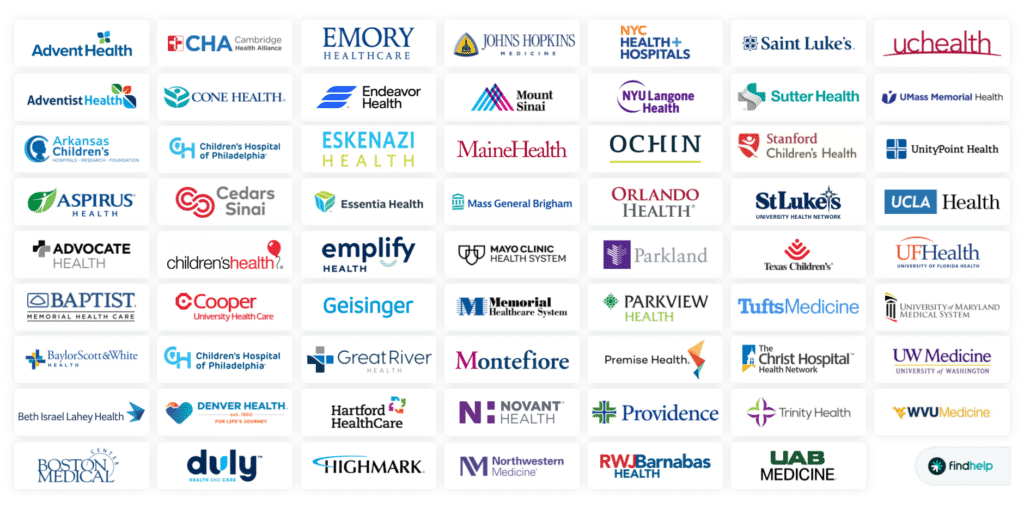
Almost 150 academic medical centers, health systems, community hospitals, community health centers, and other providers have integrated Findhelp into their Epic system using our configurable options.
Benefits of integrating Findhelp into Epic
Driving operational efficiency for staff
Organizations see immediate value when they reduce the manual work required to connect people to care.

- Employed multiple dedicated full-time staff responsible for manually transcribing community program recommendations onto Epic patient charts.
- Implemented Findhelp’s Automated Program Recommendations (a complement to their Launch integration) to find relevant programs—with zero additional clicks—for every patient who screened positive for a social care need.
- This automated workflow saved an estimated 1.3 million annual clicks and over 47,000 manual hours.

- Successfully evolved their Findhelp platform from a website-based directory into an essential, integrated operational tool.
- Implemented Findhelp’s Epic Launch integration as part of a strategic operational rollout.
- Staff adoption more than doubled, leading to a 270% increase in social care referrals.
Improving clinical outcomes and reducing costs
Connecting individuals to the right resources helps provide truly holistic care that addresses the social drivers of health.

- MassHealth’s 1115 Medicaid Waiver (“Flex Services”) unlocked $150 million to address health-related social needs (HRSNs).
- Mass General Brigham used their Findhelp platform (integrated into Epic) to send Flex Services referrals to 17 contracted housing and nutrition partners across the state.
- A MassHealth study identified a net benefit of nearly $2,500 in cost of care savings for those patients that were successfully connected to nutrition programs, alongside significant reductions in hospitalizations and ED visits.
At a regional level, our tools facilitate critical funding for community-based organizations. To date, Findhelp has facilitated over $250 million of reimbursement requests submitted directly through our platform as part of the New York state 1115 Medicaid waiver.
Empowering patients through self-navigation
Beyond staff navigation, health systems can easily integrate Findhelp into existing resources to empower members of the community to self-navigate. Customers with MyChart integrations have significantly increased site usage and access to social care.

- Launched a MyChart announcement banner that directs patients to their community site.
- This low urgency message increased site traffic 15x, spiking from roughly 200 patients a week to 3,000 patients a week.
See it in action
We recently hosted a webinar highlighting real customer success stories from implementing the Findhelp + Epic integrations. Take a look below to see our integrations in action.
Hello, everybody. Good morning or afternoon depending on where you’re based. We are really excited to have you here for today’s webinar about navigating find health in epic, best practices, and optimizations. We’ll be your host today. My name is Jeff Gam. I am a senior director of customer success here at Find Help. And my name is Rachel Harris. I’m a director of sales here at Find Help. Today’s goals and a few things before we officially get started. Our goals today are to ultimately explore our success stories from peer organizations so that you can learn from others. We wanna help you all learn how to best incorporate some of these best practices into your own social care program, and we wanna talk about, some of the recent and upcoming Find Help and Epic integration enhancements so you can learn the latest and greatest about what’s available for you all. So we have our welcome right now. We’re gonna start with a few customer spotlights of examples of health systems that Findhelp has partnered with that have done really fantastic work. We’re gonna talk then a little bit more about our network growth, throughout the country and how this can pertain to the areas that you’re from. We’re gonna then focus on how you can build success by giving really specific, snapshots of different enhancements, features, and success stories tied to specific things you can bring back to your organizations. Then we’ll end by looking forward about future enhancements and development, that will be coming soon, and we will have q and a available throughout the presentation today. So for housekeeping, if this is your first time using this platform, the webinar is going to be recorded today. We will share the recording later today automatically. So if you are on a call, you will get a recording of this webinar. And on the right side of your screen, please feel free to use the chat or the QA tab at any point to ask questions. We will answer some of those as we go or follow-up with you after the presentation for any of the questions that we’re not able to get to. Additionally, there’s also a files button that you can select if you’d like to get some additional written documentation of other case studies or stories that we’ve uploaded as part of this webinar today. And at the very end, we will also release a poll that you can fill out to gather additional information and get connected with folks from our team. So with housekeeping out of the way, we are really excited to get started, and, we always start at find help here with our mission, which is to connect all people in need and the programs that serve them with dignity and ease. Our vision is ultimately a safety net where everybody across the whole country gets the help that they need. And we wanna start with how we have seen success in other organizations be able to achieve this goal and specifically how you all are able to think about your partnership with FindHelp and being able to successfully measure ROI and ultimate attainment of those goals. ROI means a lot of things for a lot of organizations, and we know that it is especially important with current climate and, budgetary needs for organizations that you are able to demonstrate the impact of your work. And so three of the broader buckets that we think about when we talk about ROI framework and how to ultimately drive and determine value, with a product and support like Find Help. The first one is driving operational efficiency. How are you able to ultimately save time for your staff? How are you able to unlock revenue? Eliminate double documentation. We also focus on how, social care platforms and tools and the capabilities that Findhub offers can improve clinical outcomes and quality as well. So how are you providing holistic care beyond just medical needs? How are you addressing upstream drivers of health in the social space? And how are you ultimately improving your overall quality scores? We also think about impact as accelerating strategic growth. How are you building trust with both patients and with staff? How are you able to use technology to guide strategic investments through reporting, analytics, and insights, and also being able to meaningfully amplify your impact at scale. I wanna talk through now some examples and spotlights of organizations that are using our Epic integrations today that have been able to demonstrate really effectively these different types of ROI stories. The first one is around driving operational efficiency. UCHealth in Colorado has done a phenomenal job of leveraging some of our more advanced capabilities that we’ll talk about later today to have a true automated tool and and ultimately save millions and millions of clicks and time and effort from their staff. UCHealth originally had multiple FTEs fully devoted to manually transcribing program recommendations and social resources onto documentation for patients. And they realized that that wasn’t something that was scalable over time to be able to meet the needs of their really large patient base. And so in, twenty twenty five last year, UCHealth implemented our automated program recommendations integration, which we’ll show a little bit later today, and through this, was able to provide program recommendations automatically with zero additional clicks to every single patient who screened positive for a social care need. You can see some of the impact in the way that they’re able to measure the positive impact of this integration through the hours saved, in manual time, the clicks saved, and, of course, the financial impact, that can be allocated elsewhere. Geisinger, similarly, took an approach of identifying how they were able to demonstrate impact with just a single trusted network program to start. And so they identified a transportation program that they had built a really strong relationship with, but wanted to identify how could they make that process more efficient, be able to connect patients more effectively with that program in order to reduce the time and the back and forth that they were doing previously with emails, phone calls, and other modes of communication. And you can see here a detailed analysis that they did where they identified that using FindHelp and supporting that transportation program, to use FindHelp and receive electronic referrals as well significantly cut back on email volume, overall, processing time, amount of documentation required, and that led to real dollar savings in terms of, again, freeing up staff and bringing greater efficiency to the work that they’re doing. We also wanna talk about advanced health systems and organizations that have been able to not just make successful connections to social care resources, but have been able to tie those, efforts back to demonstrating meaningful clinical outcomes and quality improvements. We’re really excited about some of the work that our, partners like Mass General Brigham have done in the state of Massachusetts. MGB, for years has participated in eleven fifteen Medicaid waiver with the state called flexible services, where they were connecting patients with enhanced services for nutrition and housing needs. In partnership with MassHealth and using FindHelp as their system of record to make those referrals and capture all this data, they did an analysis of those years of data and identified that the over ten thousand referrals that were made ultimately resulted in a net benefit of nearly two and a half thousand dollars in cost of care savings for those patients that were successfully connected to nutrition programs with meaningful reductions in hospitalizations as well as ED visits. This is really impactful and powerful. This is a North Star that we want to support all of our partners with. And, obviously, this took a tremendous amount of effort and work on the health system side, but it’s an example of what true success can look like and ultimately tying the great work that your teams and navigators do back to meaningful health outcomes and improvements as well for your patients. Similarly, Findhelp, we’ve been working with the Camden Coalition for more than a decade, a bridge organization in New Jersey who works with many of the local hospitals and health systems in the region, to ultimately provide additional navigation support. Over the course of multiple years, Camden Coalition participated in the AHC program through CMS and, implanted a few community health workers in the emergency departments of nearby hospitals to do advanced navigation support and services and white glove support, to be able to connect those highest risk patients that were the highest utilizers of medical care to see where we could route them to ultimately get them better connected to social care resources as well. In partnership with CMS, Camden Coalition used all their data, analyzed it, aggregated it with their regional HIE and health system information to identify that that work not only again led to twenty thousand plus electronic referrals to CBOs, tens of thousands of assessments and searches throughout their FindHealth network, but it also led to reductions in expenditure and ED visits for their Medicare and their Medicaid patients as well. These, again, are examples of extensive efforts in multiyear programs. The example of the Camden coalition, I think, is especially powerful because this is truly the story of just a handful of community health workers that were embedded and built really meaningful relationships with CBOs and health system partners in EDs to make this meaningful in large of an impact. The last category that I mentioned that we want to focus on today is around accelerating strategic growth. This can mean a lot of things for many of you. Many organizations we work with, we know, are focused on how to be able to support and expand universal SDH screening in your EMR to be able to identify the needs of your patients. We also recognize that a huge part of that type of outreach is how are you then also providing interventions. So not just asking people if they need help, but being able to actually have a tool and a support model to be able to give them that help. And find help for many organizations is that tool. Denver Health in Colorado recently, went live with an Epic integration, where previously they’ve been using as a standalone website resource, for many years, and their staff had been using it, Findhelp, but they realized that that wasn’t the way that they’re going to be able to meaningfully scale their work across the true health system enterprise. And so after integrating Findhelp directly into Epic using our launch integration with Epic and having a thoughtful process of operational rollouts to encourage staff adoption, over the past year, they more than doubled the total number of staff usage across their Findhelp platform. You can see here some of the numbers in terms of the direct impact that had in terms of both making FindHealth embedded in their Epic EMR where it’s easier to access and baked into their workflows, operationally trained so that they knew how to successfully navigate and use FindHealth, and encouraged to ultimately make this a core part of their overall SDH and social care workflows. You can see the impact again not just in the number of staff that use Findhelp, but also the significant increase doubling or tripling the total number of referrals and connections made, created for their programs. We also see regional impact as well. We’re really excited and passionate about the work that we have done in New York state as part of their eleven fifteen Medicaid waiver over the past year and a half and ultimately not only supporting navigation and referral capabilities and building a really strong network, but also supporting reimbursements for programs and organizations that are participating in certain state sponsored waiver programs to be able to be reimbursed for the work that they’re doing. To date, Findhelp has facilitated over two hundred and fifty million dollars of reimbursement claims and requests submitted directly through the Findhelp platform as part of the New York state waiver. This is incredible and a testament to the support that we’ve done across both epic based health systems as well as community based organizations and organizations all throughout the country, to create a sustainable structure, financially for both the organizations that are navigating on behalf of people in need and the community based organizations that are providing those services to those people as well. We are very excited to share more case studies and go more in-depth about the different tools that they’ve leveraged and how you can use them going forward. But for now, I’m really excited to reintroduce Rachel who’s going to talk a little bit more about our find help network growth before we get a little bit more into our epic work. Great. Thanks, Jeff. I’m excited to share a little bit about the work we’ve been doing to continue to, expand the platform and provide more opportunities for our customers to leverage Find Help. But first, I wanna start with a thank you. We have been named best in class for five years running, and that is in part due to the feedback we receive from our customers like you all. We’re excited to hear that we continue to support you all to do the great work that Jeff has mentioned, and have seen this continue, through the feedback we’ve gotten from CLASS. Class is a valued partner of ours as we understand and take their feedback seriously to address the needs identified and ensure that we continue to strive to continue to be best in class for years to come. We are and continue to be the largest closed loop referral network in the nation. We’re excited to see these numbers grow through the collaboration with our customers and as we bring on new organizations. We work nationwide. As you see your state here, you may have some familiar friends in the state who are also using FindHelp. We’re excited to see this continue as more organizations adopt Find Help. In just the last year, we saw some really exciting thresholds. Number one, we hit over eighty million searches across the platform, saw over four million referrals, and over twenty thousand orders for goods and services. Additionally, we saw a ninety two percent close loop referral rate for referrals to and from those trusted networks. Findhelp is continuing to do work nationwide and across many industries. Though today, we’re gonna focus on our health care folks, we’re excited to continue to support organizations in the government space, in the education space, and, of course, our community based organizations. In health care, we work with over a hundred and forty eight payers, over two hundred health systems, and almost a hundred health centers across the country. Within our health system network, we support a variety of children’s hospitals customers supporting a large portion of the pediatric population across the US, as well as a large number of our academic medical centers. We’re continuing to grow the Findel platform by enabling additional referral networks, including, government benefits, which maybe some of you have heard about or seen us talk about in various other venues. With government benefits, we’re excited to support our customers with eligibility, enrollment, and redetermination into income based programs, including Medicaid and SNAP. In addition, we’re also, expanding our fulfillment services to ensure that folks that want to be really innovative with delivering goods and services to address social needs. And last but not least, our specialty networks. We’re excited to offer a post acute care network in addition to our social care network as well as behavioral health, knowing that many of these needs come, next to social care needs being, addressed. We have a number of workflows we support within the Findhelp platform. We break these down into needs identification, network curation, and case management. While a lot of these areas may come up in the stories that Jeff is going to tell, we will spend majority of our time today on integration. Specifically, Epic integration. We have a great relationship with our Epic team and are excited to continue offering these Epic integrations for our customers and beyond. We have two in, two epic integrations here that I wanna highlight. We have our launch integration, which is available for our customers to leverage throughout the epic system, as well as our native plus integration for those of you who leverage the Compass Rose and clinical case management tools. I’m just gonna introduce these as you’ll be learning more with Jeff in a moment. Additionally, we support integration into MyChart for the purposes of patient self navigation, as well as our automated program recommendations integration, which you heard a little bit about earlier to support a fully automated workflow of ingesting, an assessment from Epic and then providing recommended resources that’ll best fit the patient’s need in their ZIP code all with one click. We’re excited to continue to see more and more epic organizations choose FindHelp for their closed loop referral system and social determinants of health network. If you see our logo here, big shout out. If you don’t, we’re still excited to have you on board. But I wanna spend a little bit extra time thinking some of our newer organizations that have joined us this year, notably Baton Rouge General, Rush, Dolly Parton Children’s Hospital, University of Chicago, Children’s Hospital for the King’s Daughter, and JPS Health Network. We’re so thrilled to see the impact continue to grow across our Epic customers. In twenty twenty five alone, we saw a hundred and fifty thousand clinical staff use the platform with over three hundred, excuse me, over three point five million patients using FindHelp through the community sites. Over a million assessments were submitted via FindHelp, which led to over four million searches, over six hundred thousand connections, and nearly three hundred thousand referrals. We’re so excited about, these numbers here. And with that, I will turn it back over to Jeff who will talk a little bit more about specific work that our customers are doing to build success. Great. Thank you so much, Rachel. What I really wanna focus on now is how we build on the success of this phenomenal network that you all have built and worked with us on over the course of many years. And, ultimately, we believe that we can be a strategic partner with you to help, provide the right help the right way at the right time. And what we mean by that and for those of you that were with us on this webinar last year, ultimately, we we know that organizations are at different places in terms of their focus and strategic priorities in supporting patients, and we wanna be able to support you through the full spectrum of patient acuity in different needs that you may have in supporting your community. That starts with the community itself. How are you being able to help people, especially hard to reach folks that may be patients, but may also be folks that, are not showing up to appointments? And Findhelp can be a tool to be able to, support, those people. We also wanna be able to support all of your patients. So how are you making Findhelp part of your overall patient experience and making it something that patients are able to self navigate and use on their own? For those patients that you do see and you do screen, we have tools that can support you in having more efficient and intelligent workflows to be able to navigate and connect patients that screen positive for needs to resources at scale. For those patients that you do want to actually have navigation, so your community health workers, case managers, social workers, and others, we wanna be able to make it as easy as and as efficient as possible for your staff to be able to seamlessly navigate using our integration tools to be able to more easily connect to different CBOs. We also recognize there are many complex navigation scenarios where you may be working with patients that require enhanced needs beyond basic social care referrals, and we wanna talk through how we are supporting some of those areas as well. And then at the end of the spectrum and where you saw from some of our case studies earlier today, we also know that many of you have formal agreements in place with CDO partners or other vendors to provide not just referrals to programs, but the actual delivery of goods and services or incentives to community based organizations to be able to help facilitate sustainable, scalable network growth. And we wanna talk about where you may be fitting in one or all of these different places, and how we can support every part of the of the journey. So we’re gonna start first at its most basic at the community. These are the things that you can do to support anybody, including your patients, but anybody in the community to anonymously self navigate and search for help. I wanna highlight an example from Saint Luke’s. Saint Luke’s in Kansas City last year launched a social media campaign when the federal government temporarily froze SNAP benefits back in November. Many health systems, many organizations around this call likely had similar responses for how to be able to address and try to fill that gap knowing that many people were going to go without food benefits and struggle to be able to get the food that they and their families needed. Saint Luke’s initiated a social media campaign right as that, the benefits expired on Facebook and elsewhere to draw attention to their find help patient facing platform to be able to drive engagement and help patients better identify local food pantries in their area. You can see here a snapshot of that social media campaign as well as the impact that had as that campaign ran for the weeks during the SNAP benefit freeze. And you can see that, ultimately, they were able to successfully double the total number of patients that were self navigating during that time due to both the increased need and the increased awareness for patients that were in need to be able to get connected to those resources. Other organizations like AdventHealth who operate their own, internal food pantry and community fridge have done things like include, magnets of QR codes that direct people who are coming to get food from their food pantry to also get connected to their find help community site and self navigate to other resources. We know that patients who are struggling with food insecurity likely have many other needs as well, and this is a way to be able to provide dignity and anonymity for those patients to get the help that they need immediately, but also still have a resource that they can use to get additional support in the future. Just this week, we actually were working with an organization in West Virginia, that put out an op ed piece in their local newspaper to bring greater visibility and awareness, for, anybody in their community to get directed to their find help platform as well to, again, self navigate and get connected. Many organizations like Ryan Health and FQHC in New York City have added different things like a social care widget to be able to launch directly from their health system website to find help seamlessly as a way to direct patients who are in need directly to their find help community platform. So both the combination of digital and physical outreach, and marketing materials is really critical ways to be able to be able, to meaningfully reach potentially hard to reach patients and people in the community. So beyond general, digital and physical campaigns for anybody in the community, we’ve also seen a lot of organizations have great success with targeted outreach specifically for your existing patients. Essentia Health recently did a, formal academic research study that analyzed over the past few years the experiences of their patients and staff that have used find help, and ultimately how that impacted overall perception of trust and, value of the overall experience and health experience that they were providing to their patients. From the multiyear study, their findings identified that ninety three percent of staff that they surveyed said that Findhelp ultimately was a time saver for them, and that for patients that, more than two thirds of them reported increased trust in their providers by using Findhelp and believing that they’re being taken care of not just for their immediate medical needs, but for their overall needs, And that many of the staff agreed that ultimately using a tool like Findhelp helped them build deeper connections with patients and ultimately support their needs, not just a number or, an appointment that they needed to meet. So what are the some of the ways and tools that find help we’ve seen organizations have success in supporting this? The first is MyChart is the, lowest lift, highest impact way that we have seen organizations consistently be able to support, patient self navigation at a high volume. You can see here some examples of, both kind of the standard drop down activity item that you can add a quick button to. This truly takes no more than thirty minutes for your team to set up. And once it’s there, it is available for patients to be able to navigate and use at any time. Other organizations, like you can see from Atrius here in Massachusetts, on the left, have incorporated FindHelp as part of their overall patient onboarding experience through MyChart. And so as you’re bringing on new patients to your organization, at the very beginning, being able to direct and identify that this is a resource that many patients may want and need, having that be part of the overall patient onboarding experience to the health care that they’re receiving. I wanna highlight a few examples of these types of, quick wins, but the incredible impact they’ve had at scale. Prisma Health, just last year, announced a MyChart announcement banner to bring greater visibility and direct patients to their community site. This again aligned with some of the SNAP benefit, freezes that we saw before, And you can see that they were averaging about two hundred patients per week. We’re self navigating and connecting to resources on the Frank Health community site, which is amazing. But that announcement banner is something that was able to pop up to a low, risk notification for patients to bring in greater greater visibility and ease of access. And just by having that one announcement banner, they had a fifteen times increase in overall patient volume searching and connecting and using their Find Help community resource just by making them aware and having it be an easy one click access through their MyChart MyChart portal. So you can see here an example of when that, campaign was launched and how they jumped from two hundred patients a week to about three thousand patients every single week self navigating for resources. Montefiore, similar. They also did a MyChart announcement campaign. I apologize. Prisma is not directly tied to the SNAP benefits, but Montefiore was. And so they specifically wanted to build out favorite folders across their different regions in New York City and be able to, help patients self identify trusted food pantries and partners that they as a health system had established over the course of many years. What they did is they created favorite folders and find help of those, curated food resources broken out by the different boroughs and regions that they served in New York City, and then it had MyChart campaigns that were, triggered at the beginning of the SNAP benefit freeze to be able to drive up visibility and, again, make it as easy as possible for patients that were struggling to be able to bring food to the table, get connected to food resources. You can see here that, again, they had a significant spike in adoption. You’re seeing that as daily totals where they were averaging still dozens of patients every single day. We’re self navigating and connecting to resources before the MyChart banner. But during that announcement, it led to over five hundred searches every single day. Beyond that, it’s not just about awareness and searches, but they also saw that the patient self navigation went deeper. For every twenty searches that they had, that meant that there was ten interactions, times that people were printing or calling or sharing a program with somebody else, a family or a friend, and that those ten interactions ultimately turned into roughly one confirmed connection, meaning that they’re able to, through the find out platform, know that that patient actually did make a connection, did get in touch, did reach out to that resource, and receive those services. That’s incredibly powerful to be able to see the impact that awareness can have on downstream interactions and connections as well. Many of you have likely heard, but new for this year and something we’re very excited about is our new government benefits eligibility check. This is powered through our UNO module, and this is something that you all, as current customers, have access to today as part of your community site. If you are a current customer and you’re unaware of this, definitely talk with your customer success manager. But what this does is this is a self serve tool available for, today for all of our current customers for patients to be able to self navigate and identify what government benefits like WIC, TANF, SNAP, Medicaid, and more they may be eligible for and receive a personalized savings guide to help walk them through how they can get connected to those resources. This is an explicit expansion and a great new feature beyond just a a a great network of social care resources and community based organizations, expanding support to also include state and federal government benefits. Again, this is something that is new but available today for all of our current, partners. This is something that you can also incorporate into your MyChart campaigns, into sticky notes and flyouts on your FindHelp site, and other digital and physical marketing for your patients to be able to self navigate. So next, I wanna shift gears a little bit and talk about what you can do to use FindHelp to support not just patients self navigating, on their own, but for patients that you explicitly screen in your Epic EMR and that screen positive for needs, what tools does FindHelp have available to help you be able to address and meet those needs? One of the advanced integrations that we have that we have dozens of organizations that are live or implementing this today, and we’re very excited about is automated program recommendations. We talked about this at last year’s epic webinar. This is something that we’re very excited about and have been live with for the past couple of years now. But this is a truly, fully, one hundred percent automated ingestion of patient program recommendations back into the patient’s chart and after visit summary in English and the patient’s preferred language in real time with zero additional clicks. This is a fully automated workflow that’s designed to complement the navigation that we’ll get to a little bit later. To provide some quick visuals of what this looks like, in practice, this integration gives you the ability for your staff to be able to conduct their screenings in Epic like they are probably already doing today. And when they complete that screening, they can click that close button to finish their screening. They may not know about find help or that find help exists at all, and that’s okay. By simply clicking that close button and finishing the workflow that they are already doing in Epic, in real time, that program information is captured and being sent to find help. In find help, map to relevant applicable programs identified based off of curated trusted partners that your organizations identified, filtered down automatically to only provide those that that serve that patient’s area, and then in real time, sent back as a note into your epic chart in both English and, if appropriate, the patient’s preferred language. And in real time, you can have that information pull on to the after visit summary. And so many organizations are, again, already doing this today. But at the highest level, this is intended to be a catch all so that every single patient that you screen, at the very least, gets some kind of an automated no effort program recommendation on their after visit summary before they leave their appointment or are discharged from the hospital is a way to make sure that as you’re screening for needs, you are still able to provide a meaningful resource for every single patient that comes through your doors. We’re very excited that new this year, in just recent months, something that we created is an ex an enhancement to this existing automated program recommendation integration. We’re calling it our version two. And, ultimately, it brings greater stability, greater speed, and ultimately, also provides a portal that you all can use to be able to update information real time. So if there ever is a technical issue for troubleshooting, you’re able to do that directly. It also allows you to make quicker updates. So if you’re, if you change your Epic SDH assessment questions or you wanna modify the types of programs that are being recommended based off of a certain question and the needs that a patient may have, you are able to do that in real time directly through the platform through our new APR site admin portal. We are also very excited that coming soon, in the, coming weeks and, next month or two, we have some new improvements for organizations that are currently using and are interested in using this automated tool that’s gonna include improved formatting. So being able to, have the output on an after visit summary be even more polished, more concise, and a better fit with your AVS formatting, as well as additional control to give you the ability to determine how many programs are actually added to an after visit summary. So that way, you’re not overloading, you know, paper or valuable real estate in an after visit summary, but you’re providing just the most important concise program information that a patient may need. Again, this is coming very soon, and we’re very excited about the development work and explicitly the partnership we’ve had with some of our earliest adopters to guide us and give us direction on how we can continue to improve and evolve the work that we’ve done here. To highlight one of those partners who’s been a great thought partner with us throughout this journey and the first organization that ultimately implemented this integration, NYC H and H, the largest municipal safety net hospital in the country, first implemented this years ago. This is just a snapshot from just their first six months of go live where they were able to support over a hundred thousand patients that were screened during that time. And not only were they able to have this, really valuable, high touch, thousands of hours saved automated tool, but it also, was accompanied by advanced navigation support that they are able to do to send over ten thousand electronic referrals to their trusted CBO partners. We’ll talk about that a little bit more later. But just to give you a sense of the size and scale, this is designed for all organizations using Epic, big or small, to be able to have a fully automated, truly, system wide approach to being to being able to address the needs of your patients. We also work extremely closely with Epic and are continuing to work and support them in developing out their own internal and native features as well. We’ll talk about that a little bit more later in the webinar, but we have, worked with Epic to be able to support their own after visit summary, native integration as well, allowing you to be able to receive a pop up if a patient has screen positive for certain needs with find help recommended programs available for your staff to select and determine whether or not they wanna be added to the after visit summary. These are both very viable, great tools for you to be able to, again, provide these program recommendations at scale to your patients. Next, we wanna talk a little bit about efficient navigation. So everything we’ve talked about up to this point has been around self navigation, patients looking for resources on their own, or automated tools to support you at scale to provide recommendations to programs, but not necessarily make an actual referral or a connection to that program. What we wanna focus on are tools that you can use with FindHelp to be able to more easily and efficiently facilitate these CVO connections based on the patient’s need. The single most important thing as you are either starting or later in your FindHelp journey is that, ultimately, the navigators and the folks that are doing this work are going to have different workflows, different needs, and different patients that they’re working on. And our team is here to work with you to be really deep and thoughtful about which users are ultimately conducting as to each screenings or navigation or following up with patients and what are their workflows to make sure that Findhelp is as seamlessly as possible embedded in those workflows. We have a very detailed comprehensive, excuse me, implementation guide that we’ve created over the years from the hundreds of different Epic Health systems that we’ve worked with to identify how we can support. And as an example, we’ve worked with organizations that in the inpatient setting have social workers that wanna be able to complete their STH screening and immediately jump to different resources that they can refer and connect patients to. We’ll talk about our assessment informed launch and how that can support that. We have case managers that wanna be able to see what referrals have already been made for a patient that maybe was discharged previously or has been supported by others throughout the organization. We have the ability to make it so you can directly launch to the find help patient chart and be able to see a full history of all those referrals that were made in real time. We also have community health workers or others that are trying to just do standard search that maybe haven’t conducted a formal screening, but they do still wanna be able to help connect a patient’s needs, and we have ways of supporting that too. So to start with efficient navigation, we have over a hundred and thirty Epic health systems and organizations today that are using our Smart on Fire launch integration. This is our most common integration. It is a fairly light technical lift, but a fully advanced and valuable integration that we’ve seen really high levels of success across the board with many of our partners today. Our launch integration is flexible. It can be embedded in various workflows, anywhere throughout your inpatient and outpatient settings of care. The Find Help experience is embedded within your Epic iFrame, giving you the ability to all Find Help’s advanced tools, looks, and feel, but still have it baked within your Epic workflows. As an example from Boston Medical Center in Massachusetts, this is how they’ve incorporated their workflow in one part of their workflow, excuse me, to ultimately support their navigators. And so you can see here from their epic snapshot report, they have a one stop shop that they’re able to conduct a screening in Epic for social care needs, be able to see the different needs on this SUH wheel in Epic, but then also have multiple launch points depending on what that navigator needs to do next. So they have the ability to, in one click, immediately begin the process of starting a search or creating a referral for, two programs. They also have the ability of immediately seeing what types of referrals have already been made for that patient as well if they wanna start by looking, at the historical context of the patient in the programs they’ve connected to. Launch is a fully bidirectional electronic world, workflow. You are able to send electronic referrals, both basic and advanced, to CBO partners and be able to receive electronic referral responses back. You can see here, this is an example from the screen before. On just one click, you can immediately launch to the find help secret profile and be able to see the full history of all referrals made for that patient as well as any notes and communication with that CBO and the status of those referrals as well. To highlight some specific success stories and examples of this in practice, Children’s Health in Texas has done a fantastic job of being able to roll out their launch integration to provide meaningful value and support for their staff. They had a soft launch, last year, but ultimately identified earlier this year that they wanted to have a formal staff training, and rollout process to really make making referrals and find help a core part of their social care workflow. You can see here the direct impact that that had, increasing from about twenty referrals per week from their staff to about four hundred referrals per week from their staff every single week just by focusing on how they can make find help more meaningfully embedded in the right encounter and navigator workflows and train so that this is a core part of their workflow experience. We’ve seen similar things with UC Irvine out in California, who by adding a simple, one click launch point from their Epic storyboard, which is valuable real estate, but by having that front and center so that anybody within Epic, that is supporting a patient has easy access to be able to immediately jump in and see what referrals were made for a patient and how they can better help them address social care needs. Through that immediate jump, you can see here the spike in usage that they had, from a couple years ago, just by adding that easy access point for staff to be able to, quickly launch and navigate for patients. Last one I wanna highlight here is Gunderson, now Amplify Health. Gunderson at the time, had a volunteer program. We had a little over a dozen volunteers that they had focused on doing this this navigation activity embedded in the health system alongside community health workers, doctors, and nurses, to be able to meaningfully identify patients who are in need and spend the time with them to ultimately connect and, provide the programs and resources they needed. You can see here that over that three year period, the dozen or so volunteers created over fourteen thousand electronic referrals. They supported nearly three thousand patients, and they also had a meaningful impact in building stronger relationships and partnerships with programs throughout the their network as well. This is an amazing example of how even nonclinical staff can have incredible impact in in, power for patients and meaningfully change, the way that you are addressing social care as an organization. There’s a question in the chat a little bit earlier, and I know many of you have had questions about how this can also flow back into the Epic patient chart. It can. Our launch integration, by using our MySQL database absolutely has the ability of pulling referral and navigation information back into your Epic patient chart automatically so you can avoid double documentation and be able to have the information stored directly in your a Epic patient chart as well. We have dozens of organizations that have done this to date. And, again, this is view as mock up, but an example from one of those organizations in Massachusetts who designed this so that they have a print group that directly displays the program provider referral status and date of the referral of all the programs that a patient’s been referred to so that a any navigator in Epic can stay in Epic to be able to see that historical referral information and make a determination if they need additional support and find help as well. Something we released last year to continue to improve our network and bring greater efficiency for staff is our program manager tool. This is a new tool that your staff are able to use today to be able to make real time updates, to programs or add net new programs directly to the network in real time. You still have the ability to interact with Findhelp’s creation team to suggest edits or or request changes, but this is a way to be able to make more real time direct edits for you and your staff as you go. Findhelp is still ultimately the accountable owner of maintaining the network accuracy and making sure information is up to date. We moderate updates that are made to the network to make sure that they are accurate, but we wanna reduce the the friction and barriers to making sure that if you have a program that you know is important for your patients and your community, that you have the ability to update that in real time. This is something that, benefits everybody that is part of the Find Help network. I mentioned a little bit earlier, but one of the enhancements that we strongly recommend for all organizations that use our launch integration is what we call assessment informed launch. This is a way to be able to ingest your assessment data from Epic that your staff are documenting. And in that one click when you launch to find help, not just do a standard open search, but use that SDUH screening information to drive a curated navigation experience. An example you see here on the screenshot, this is an example of a patient who screened positive for food insecurity and utility support needs, and the navigator is immediately directed to preselected programs that you have an org as an organization have identified as your default preferred trusted partners to be able to send referrals and connect patients to those needs. It does not stop you from interacting with or connecting with, all of the other hundreds of thousands of programs in the FindHelp network, but this is a way to be able to streamline your staff workflows and make it so that they can, from one screen, quickly go through, connect patients to your preferred partners, or even be able to print off that list and hand it to the patient, in one fell swoop. An example of this in practice, Allina Health, in Minnesota recently went live with assessment informed launch where, again, their staff are making a concerted effort of being able to complete SUH documentation in Epic. What they identified is that just in the first two months, this is new as of earlier this year, they ingested over six thousand patient assessments that were documented in Epic. And from those, Alliance staff have shared and interacted with over nine thousand programs, to connect and share those program information with patients just in the first two months of going live with this more streamlined, enhanced Epic integration that we offer. For the those of you that are on our launch integration or are interested, we do have a new version that we released at the end of last year called our version one point four. We strongly recommend and encourage all launch organizations to upgrade to this newest version before the end of the year to have improved stability, to align with future epic version releases, and to enable some advanced features like the ingestion of additional data to streamline future enhancements and development and support coalition sharing, which we’ll talk about in just a little bit. So I’ve talked a lot now about ways that find help can save clicks, expand impact, make it easier for your staff at scale to be able to connect and, share program information with patients. I next wanna focus a little bit on some of those more complex navigation activities that require more time, more engagement, and where efficiency is important, but, ultimately, there’s additional support and navigation required. We’re very excited to announce that coming soon, just in the next couple of months, is going to be a new feature called advanced search. This is a in addition to the current search experience that your staff may be used to today, but an option for them to have a more advanced search experience to be able to drill down even faster to the programs that they need. This allows you to add additional filters or social care needs in one place rather than having to search multiple different needs in different pages at different times. It also allows you to filter out programs. So being able to filter out programs that maybe serve veterans if your patient’s not a veteran or being able to support, only young adults or only new and expectant mothers. So more information will come on this very soon, but we’re very excited to announce that a new, improved, enhanced search experience will be coming for all organizations here this fall. Find help also supports as part of complex navigation what we call coalition sharing. This is optional, but something that we encourage for organizations that have built really close partnerships with other organizations in their community to provide a truly comprehensive longitudinal record of care. In Pennsylvania, for example, we work with many health systems that currently are participating in data sharing agreements and using FindHelp as a way to be able to see referrals made by other organizations as part of that initiative. You can see on the screen here, this will give your your staff the ability to both complete their own standard referrals and workflows, but also be able to see any referrals that were made from another organization using find help to get a better comprehensive picture of a patient’s total social care history. This, again, is something that we’ve been live with for years, are continuing to roll out and expand to other organizations. We’re very excited about, continuing to support this for organizations, as more and more organizations form regional, coalitions and initiatives to work more closely together to support patients in need. One example of this is in Tennessee. Baptist Health is participating in a state Medicaid initiative called Tencare. And as part of that initiative, organizations throughout the state are participating in coalition agreements to be able to share their longitudinal social care record across organizations with each other. Baptist just quite recently, officially onboarding completed their coalition sharing and is now both contributing and being able to see that type of longitudinal social record of care. Find help. We take patient privacy and consent extremely seriously so patients have the ability at any time to determine their consent and whether information can be shared outside of the immediate organizations that’s working with them and if they’re okay with having the information shared with the broader coalition. And that is something that we are going to continue to support in the future as well. Other types of advanced work that we are doing with organizations that are continuing to push the needle and what social care can do. We have the ability to ingest and display payer coverage information and be able to use this to to determine eligibility of different programs and drive more intelligence searches. We work with many organizations, for example, that have patients that, are insured by Elvins as part of their SDH provider incentive program. Elvins is able to provide incentives to providers and organizations, that support patients who have different types of social care needs and potentially getting them connected to different enhanced services as well. This is something that we’re continuing to expand as we deepen our partnerships with both payers and providers to make sure that value added benefits or other payer specific types of, opportunities or surface for those patients that are eligible. We’re also working with organizations that are doing more advanced code mapping. So in New York and other states, throughout the country, we are working with health systems to include LOINC codes, HCPCS codes, and others into different types of screeners or fee schedules to be able to associate the activity that your staff are doing with coding as well. As part of our other advanced navigation tools that we support, we support in addition to our launch integration what we call Native Plus. We’re very proud to be recognized by Epic as a toolbox vendor, meaning that we work very closely, with our Epic counterparts to be able to deepen and mutually align on how we can support our shared partners as part of this joint development initiative. For many organizations, if you are currently using Epic’s Compass Rose module, or have heard their CRD or CRN activity, Find Help directly supports and powers those as well. Find help, and this screenshot example has the ability of having program information natively used in Epic, meaning you will have the look and feel of Epic, but with the find help, full power of the network, embedded and incorporated into your Epic workflows with the ability to send electronic referrals out to those programs with FindHelp being the powerful engine behind the scenes, facilitating those referrals and the statuses of of those referrals coming back in as well. This allows you the ability to, again, use Epic’s tools and functionality to be able to still tap into Find Help’s robust network of programs and be able to search, connect, print, or add to the after visit summary program information, to continue to support your patients. New this year, for those of you that are on Compass Rose or are currently using the native integration, we do support and are live with HCS or service line files. This is an update Epic has made to provide greater streamlining and ease of use to be able to search for different programs that may be offered by the same provider. If you are a native, or native plus organization, that has not used this or heard of this today, please talk with your customer success manager. This is something that they’d be happy and excited to support you with. Something else that we’re very excited about as well is that, coming soon, we’ll be releasing the ability for our native organizations to, manage the find help network natively through Epic’s Nebula Cloud. Like I mentioned, our engineering team works incredibly closely with Epic. Myself and many other leaders from our company, visited Epic’s headquarters just a couple of months ago and are continuing to drive joint work together to be able to improve and expand the work that Epic is able to do natively today. This Nebula is an exciting update that will bring, the ability to maintain program information in more real time and more automatically with less IT resources to greater parity with what our launch integration currently supports today. But we are currently in the early doctor phase and piloting this with a few groups, but this is something we expect to be rolling out more broadly for our native and native plus organizations later this year for organizations that are interested and excited to take part in this. Like I mentioned, find help is still powering the actual network and resource directory, and ability to connect and create referrals to programs. This is a quick snapshot of the type of information that is available natively in Epic and as part of the Nebula project in particular will continue to display. So the content and the referral capability is still powered by find help, but just interacted and viewed in a different lens using Epic’s tools. For those of you that are using native plus, we have about twenty organizations today that are doing so. We continue to solicit your feedback. Please continue to share with Epic as well. We know that there are many ways that this is gonna continue to evolve and improve over time, and we have shared that feedback and work closely with Epic on being able to support that as well. Things that we are working on that we know are going to be incredibly important. Epic is working on expanding this ease of search to have a more elastic and flexible search experience in the native plus environment later next year. We are working with Epic to be able to support not just basic referrals, but how to be able to pass and share more advanced information like our screeners or scheduler information for CBOs that require, nuanced and discrete fields of information to determine eligibility before they can provide services. We’re working with Epic to improve end user messaging to make sure that patients or excuse me, navigators are getting in basket messages and information to be able to see the status of referrals and if there’s any errors in being able to submit those referrals. And we’re also working with Epic to find ways to make it easier for those trusted partners that you’ve identified and built relationships with to surface higher in search results and be more visible for your staff so that your staff by default are connecting with those programs that you’ve built relationships with and have a a higher response rate from. The final category that I want to talk through today is for advanced organizations that are looking to not just search and connect or refer patients to resources, but are also looking to order resources, actual actually purchase in the delivery of goods and services or directly incentivize CBOs for the work that they are doing. We’re really proud to partner with many fulfillment and marketplace services. You can see a snapshot of some of them here that you can use FindFold for directly to be able to connect and refer, to these organizations to, again, not just refer to a resource, but actually provision a service. One example is Uber Health. We are live with Uber Health with multiple health systems today where directly through your FindHelp platform, you have the ability of ordering a ride for a patient to medical appointments. Patient does not need to pay. They do not need to have the Uber app or a smartphone. They simply just get a text, telling them when their ride has been ordered. They can just select one, and text back when they are ready for that ride to pick them up, and it’ll drop them off at their preset location. We’ve seen organizations like MaineHealth use this very effectively for hundreds of patients every single month to reduce, no show appointments and ensure that patients that struggle with transportation access are able to get to their medical appointments in need. Like I mentioned earlier, we support coding, and so we have many organizations today that are using coding to be able to support CBO reimbursement requests and for CBOs to actually get paid for the services that they’re doing. This can happen at the payer level. This can happen at individual MOUs or partnerships that, US health systems may form with CBOs, and we’re also seeing this happen at the state level. Our goal is to ultimately facilitate those different types of incentivized partnerships in being able to create a more sustainable safety net for all CBOs and organizations involved. To highlight some examples of this in practice and where we’ve seen great success, in past years, Johns Hopkins has had a phenomenal job of rolling out, their Find Help network using our launch integration to staff and also invested directly in incentivized CBO relationships to encourage programs that they built relationships with to have the, tools and materials needed to be able to successfully respond and demonstrate patient outcomes. Through that period of time, you can see that Johns Hopkins has created nearly seventeen thousand total referrals just to their trusted CBO partners alone. And for those trusted CBO partners, in large part because of the great work they did in building both relationships and incentivizing their support, they have a ninety two referral response rate and a seventy eight percent referral closed loop rate from those seventeen thousand referrals created. Similarly, we have a a partner in Pennsylvania, who provided five thousand dollar funds to CBOs to ultimately onboard to find help, claim their program, enable electronic referrals, and be able to, build a closer relationship and data alignment with their health system as a way to incentivize CBOs again to build stronger relationships. You can see this example here that nearly three thousand referrals were created as part of this pilot project, and that they had an overall ninety four percent closed loop rate and a ninety six percent referral response rate because of the incentives in the partnership that this health system formed with those CBOs. Last case study here I wanted to highlight is from Highmark and Allegheny Health Network, where they ultimately did a study to identify their incentivized partnerships, where Highmark Health directly invested and incentivized thirty seven different community based organizations throughout their network to, again, onboard enable electronic referrals, but also the financial support and relationship to be able to manage the inbound referrals that they were receiving. They conducted, an academic article that we’re happy to share afterwards if interested of the nearly two and a half thousand referrals that were made to these trusted CBO partners. And, ultimately, they identified that the overall cost benefit of incentivizing and supporting these CBOs had a positive ROI even after factoring in the incentives that were given to those CBOs. You can see that Highmark, from the study found that it resulted in a nearly over six hundred dollar per member per month savings, reduction in inpatient admissions, and extremely high close response rates from those trusted network CBOs. So my hope here is that this is to inspire you, and give you insights into both the tools and direct capabilities Find Out Pass that you can incorporate back into your system, work with your CSM or sales reps to talk more about, and also to give you a sense of some of the peer organizations and partners that we’ve worked with over the years, what they’re doing, we are more than happy to facilitate connections, introduce you to other organizations so you can continue to learn from the broader Find Help network. So I know that we’re coming up on time here shortly, and so I wanna, help us close out by looking forward. To recap some of those things that we talked about today, Available now, we have many new, and existing tools that we’re very excited about that you can bring back. And if you don’t have live today, we strongly recommend that you talk with your Findhelp representative. We have the ability today that you can re ingest automatically referral information back into your Epic patient chart so that you can see referral information directly in Epic without even having to go to find help. Staff and, others in the community are able to use the program manager tool to make real time programmatic updates to make sure that the information on the find help network as as up to date in real time as possible. We support both standard and assessment informed launch. Assessment informed launch is able to directly tie the work that you’re doing in screening patients for an epic to curated program recommendations in Find Help to reduce the number of clicks and steps that your staff are taking. Automated program recommendations complements the work that Launch and Native Plus can do by providing a truly one hundred percent zero click fully automated, ability to add program recommendations onto an after visit summary for every single patient that screens positive for social care need. We support coalitions. So as you are forming relationships with other organizations in your community and you want to be able to see referrals that you are making for a shared patient, we have the ability to support that as well. We continue to participate in the gravity project to align code mapping and bring greater standards across the whole industry for how we can support future policy and road mapping around reimbursement encoding in the social care space. I highlighted briefly some of the examples of how you can also not just refer, but also order goods and services directly through the Findel platform. We have other integrations that we support, including our more native integrations with Epic, largely tied to their Compass Rose module, where we have, in the past year, received a toolbox designation, meaning that we are working more and more closely with Epic developers directly on how on how we can continue to mature and expand that integration to be a valuable enterprise wide strategy. And new this year, we do support Epic’s HCS and service line data structure. We also talked about MyChart and how there are many ways that you can support patients in self navigating connecting to resources on their own time as well. To highlight very quickly some of the things that are in development and coming soon as well as things that are on our radar and we are excited to talk about in future webinars. Currently, we talked about how we have the ability for patients to self navigate on our echeck or electronic check government benefits platform. That is live and available today for all organizations. Something we’re very excited about, rolling out later this year is our government benefit enrollment navigator tools, a tool that your staff can use as a way to actually help patients enroll in those types of state and federal government benefits. I mentioned that we have been working over the past year very closely with Epic to be able to support Nebula and have Epic actually house, host find helps network directly in Epic to reduce your IT time and be able to provide more real time programmatic, information updates in your epic environment. We are currently live with this today and, with some of our early adopter partners and are excited to announce when this will be more broadly available for all of our native organizations later this year. We also talked about how we have an advanced search that we’re very excited about and will be coming out later this fall to give your staff again the ability to search and connect resources more easily and with fewer clicks. More details will also come out on that, but that will be coming out and available later this fall too. Some of the things that are further out, but are continuing to be in discussion, especially as part of our close partnership with Epic, are continuing to support and encourage Epic in some of their development work to expand some of their more native integrations to align with some of the more advanced capabilities we know many organizations want and use today. We also continue to work with Epic about how we can continue to streamline the ability for launch information to be able to be pulled back in in real time. But like I mentioned, we do have, the workflow of using our SQL database that, dozens of organizations are currently live with today as well. So I know that was a whirlwind and a ton of information. With that, I’m gonna go ahead and turn over to Rachel to wrap us up and take us away from here. Great. Thanks, Jeff, and thank you all for sticking with us as we learned about some amazing work that our customers are doing, with their Epic integrations. We’re now gonna put out a poll. If you’re interested in learning more and you’re already a part of the Findhelp community, we’d be happy to connect you with your customer success success manager to talk more about these epic integrations and the great work that your colleagues are doing. If you’re new to Findhelp, we’d love to chat with you. So please let us know if you’d be interested in learning more. With that, I’ll jump into, some, events that are coming up, here, in the next couple of weeks with us. If you’d like to see our faces again, you can join us in Illinois, specifically in Chicago, on September ninth from nine to five. We’re excited to host a number of wonderful customers and attendees, including leaders from OSF and Northwestern. We have the link for registration in the chat on the right. Additionally, we are supporting a DC, Maryland, and Virginia social care summit. That will be September twenty third, nine to five based in DC. Excited to see some of our, DMC folks, come say hi. The link for that registration will also be in the chat. Additionally, come say hi to us in Nashville at the behavioral health tech conference. We’ll be talking a little bit more about our behavioral health specialty network. That’ll be September twenty second through the twenty fourth. And last but not least, if you’re planning to, join us in person or you just wanna check out more information about the Findhelp platform, please join us for our free monthly trainings or watch our on demand tutorial videos, on our website. Thank you all again, for joining us today and learning a little bit more about the amazing work that our Epic customers are doing. And I hope you all have a wonderful rest of your day.
Integrate social care into your clinical workflows
Every health system’s technical and clinical goals are unique. The nation’s leading health systems use Findhelp + Epic to simplify staff workflows, meet health-related social needs, and strengthen community connections. If you’re ready to explore which Epic integration pathway best fits your organization’s specific workflows, connect with us.