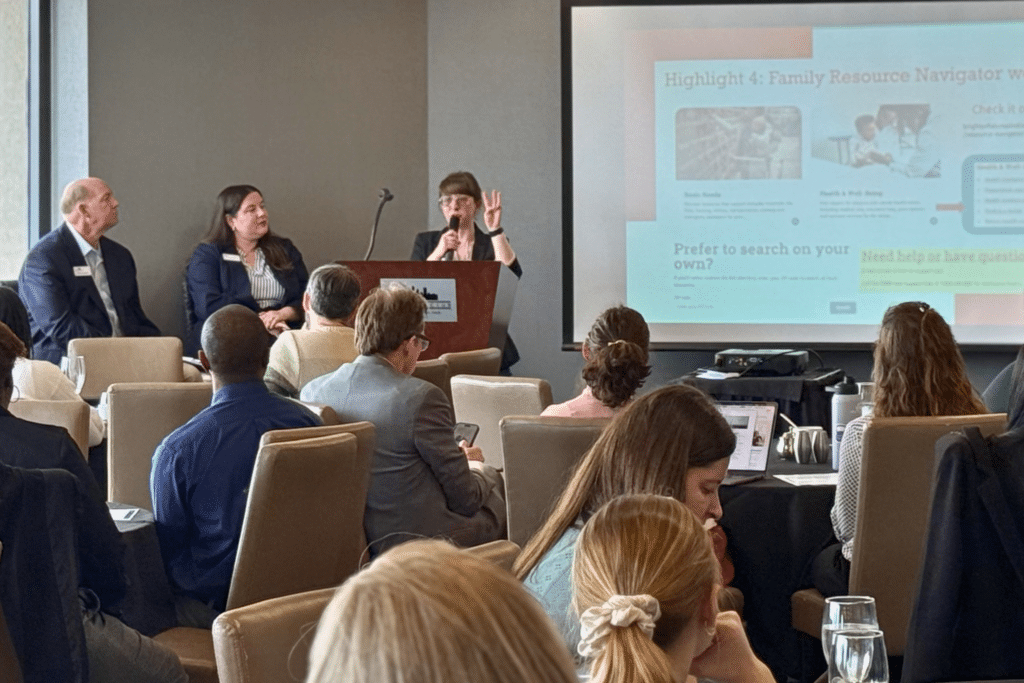
I’m super excited to have the opportunity to teach you a little bit about school care, what it does, how it impacts the community, particularly in Indiana. I’m super happy to have Mary Hess with me here, my partner in crime, as far as spreading the word as far as all things school care. So to help you better understand and orient you about what school care is, what it does, I wanted to give you a few slides just so you can kind of understand. That’ll give you more context for Mary and I’s conversation in a in a little bit. So I already introduced us. So as far as footprint is concerned, we are national as far as school care is concerned, but we’re really focused on Indiana, Kentucky, and Ohio. But we are national. Like I said, we’re in thirty one states. We have two over two million members of school care. We’re in fourth over four thousand schools. Nine million medical events a year, are are charted in school care. So pretty impressive footprint as far as that’s concerned. Big thing for us, we are free. So school districts do not pay for school care. There’s a few ways in which we really kind of subsidize it so that school care can be free. That’s super important. School nurses are also usually underappreciated, underserved as far as in school districts are concerned. So super important that we offer for free. So our Indiana footprint, we are in forty five corporations statewide currently. Jill and Karen from Community Health Network, where are you? Hi. Hi. Hi. Hi. Hi. So they were instrumental in bringing us that number is actually going to be soon. The contracts are out to talk to. Community Health Network serves thirteen corporations in the greater Indianapolis area. Well, two charters, eleven districts. And so super excited to be joining Community Health Network and and working with them. So districts actually will be about almost sixty, so super great as far as that’s concerned. But we we serve all districts big and small throughout the state, largest in the state to the smallest, most rural. All of us, you know, all of them need our help and support, and so we’re super excited and super proud of all our Indiana partnerships. So school care, what is it? What do we offer? So centered to what we do are two programs, care coordination and Medicaid billing. These are really the two programs that make sure that we are no cost. I’ll go in more detail about those, but I like to start there as far as how school care because, you know, it’s free. That’s usually a a very common question that we get. And so it’s because of those two programs. But kind of orbiting those two programs, real quick, just touching on what we offer first and foremost for school nurses is a no cost student health record platform. So HIPAA, FERPA compliant, super important that we protect that student data. The goal is really simple. We want nurses to easily put information into the platform, just as importantly take information out. Because, you know, obviously, it’s great to have a database to store everything, but we want data to inform nurses and really be an advocacy tool for them so that they can show how busy they are in the health office. I mean, I touched on it. Nurses are oftenly, unfortunately, overlooked as far as their importance in the school district, how they serve the macrocosm of that district, make sure that that student is healthy and happy every day and meeting their learning outcomes. Nursing is is huge part of that. So we offer that platform to help them really chart everything that’s happening in their health office, and then they can report out. So we have over fifty reports they can download and export so that they can show everything that’s happening in their health office to administrators, parents, teachers as needed. Something else we do, which is a huge feature, is that we sync with CHIRP. For those that don’t know, CHIRP is the immunization database in Indiana. And what this does basically is that every three days, school care pulls that immunization data into our database so that nurses don’t have to search for it, and they can have that immunization data at their fingertips. So they can run reports. This is usually a huge time consuming thing for school nurses. They’re already super busy. They see tons of students every day just coming into their health office unannounced. They another part of their job is to actually follow that immunization data and make sure that student has up to speed with all their shots. So we help with that. That saves them months of time. So it’s so it’s really important. And then another piece, last piece, is communicating health visits with parents. For those of you who have kiddos, you know, if you see that you wanna go to the students at their health office that day, nurses have a few ways to communicate that out. So one way, they can have it where they can, in real time, email the parent after the student visits the health office. They can also have it where an automatic email goes out later that evening. So that’s great. That’s hands free for them. And then we also have a parent app. So it keeps thirty days of medical events on there. Parents can check-in and and and really keep abreast of of their students. So that’s particularly important if the student’s chronically ill, they’re diabetic, they see they got their insulin, was sent back to class. So a really important tool. So care coordination, I wanted to explain a little bit about this program. We’re super excited about it. We’ve launched it in Ohio. We’re trying to get it underway in Indiana. So for those folks that are in population health, for those that are are at your managed care organizations, we’d love to chat with you about the potential of this. So let’s talk about how it works. So first and foremost, we take care of the opt in. So we get families decide if they wanna participate in care coordination or not. We send out a message usually around springtime registration. When a student’s signing up for school or the next school year, we can piggyback on that. And we basically just say, would you like to participate in care coordination? We say a little bit about the program. But basically, once they opt in, now that student is considered active in the system. And the great part is is once we work with the health plan, it’s really kinda hands free as far as the help is concerned. We’ve set it up essentially where the student can visit the health office. So say a nurse has a student, you know, can come see Mary four times in a week with respiratory issues. Nurse can chart that in our system. That way then they, have a way to track that. And then a case manager at the health plan is alerted essentially, and then they can do real time intervention for that student. So we share risk stratified data with the health plan for the students that are opted in to care coordination. We’ve also recently created a two way messaging system between nurse and health plan case manager so that there is a communication way or tool for them to communicate with each other so they can better coordinate care for that student that needs help in real time. So it’s super important program we feel. Like I said, we’re working real closely in Ohio with UnitedHealthcare, but we wanna bring this to Indiana. And so hoping that maybe we can make some connections today to make that happen. I talked about the secure messaging. This is basically just a screenshot from school care just as far as how it looks and how that’s communicated. This is what the nurse sees as far as that and the consent piece, to that. So all securely, presented as far as that’s concerned. Talked about the app. So this is just a screenshot of it. The other thing, and this is where we kinda cross over with Find Help, is that they can access Find Help programs as well through our app. So it’s really a one stop shop as far as that’s concerned and really helpful for families as they need to find programs or check-in about their students’ health. Alright. So Medicaid billing, and this is something that Mary and I will touch on in our conversation here in a little bit, but I wanted to give you a little bit of context as far as what Medicaid billing is and how it affects nursing in Indiana. Pretty specific things, so wanted to cover that very quickly. So now in Indiana for Medicaid, you can bill for students that are enrolled in a five zero four IEP or students that have an IHP. So five zero four IEP, these are students typically special ed that are enrolled in that. IHPs is a much wider definition. So basically, individualized health plan. There’s a ton of acronyms in education. But essentially, these are ways in which that now when a student visits the health office, the nurse can better help and support that student that’s Medicaid qualified. There are some steps. This is the first step, so there’s IEP five zero four and an IHP. And again, Mary and I will talk about that a little bit. But we also have to have Medicaid consent from the family basically saying it’s okay to enroll their student and and to and to bill for them. With an IHP, we’ll also have a summary plan of care. We’ll need a school nursing physician’s order as well, and then a release of that medical information, like I said. So once we compile all that, we’re good to go as far as billing for that student. And and that’s super important because we talked about it as far as the health office being underserved. This is one way in which we can show and shine a light on the importance of nursing to better help and support the school districts. You don’t have to tell any of you. We see it in the news all the time. As far as districts struggling financially, this is a way in which we can bring money into the district. So it’s really important. And we’re starting to see this really grow in Indiana. Currently, SchoolCare works with almost twenty corporations now, which is amazing. And this means better support for the for for those districts. But essentially, once that we compile all this, we create a tab in SchoolCare. You can see it. I know it’s bit of an eye chart. It says Medicaid. And that allows the nurse to know that they have a student that qualifies, in order to bill. So we compile it all in one place, easy for them to to access. As far as how it breaks down cost wise, so on the, right here, the fifteen ninety five rate, that’s for an RN. Not every district has RNs. Some do at least have one, and on the left there is the LPN rate. So it does vary a little bit, but for every fifteen minutes that student’s in the health office, they can bill that amount, and school care bills just a small amount on the end of that. So really the majority of the lion’s share of the money goes to the school district or corporation. So what we track, right? And this is the advantage of using school care as their student health record is because this is automatically being tracked on the back end. So duration of visit, procedure code, unique service ID, site code, all of this is done for the nurses. This is one less thing they have to worry about, And they can go back to doing what they should be doing, which is treating kids and making sure that they’re getting the help they need. But really nice as far as that’s concerned because a lot of times they’re using disparate programs that don’t capture this, and that’s more time that the nurse is having to take and track that information. So as far as the billing, that piece is actually pretty easy. So we compile, like I say, on the back end. We create a report of that information. We make sure that everything is entered correctly. So we do some validation on the back end, make sure the nurse entered the time and date stamped correct, all that good stuff. Once that’s done, then we submit the response to the state. In Indiana, the processor is called Gainwell. They’ve worked since the nineties, I believe, with the state. So it goes to Gainwell. They process, and then that reimbursement comes back to the district. And then school care bills on the back end of that, and we have a small processing fee of forty cents per child, which essentially is about two and a half percent. So we’re proud of that because we feel that’s a very good low number. The majority, like I said, goes back to the the school nursing program so that they can invest back in the in this into the school district. So like I mentioned, as far as current contracted, this number isn’t quite right because we just went up as far as community health network pretty dramatically and doubled. So our pipeline is kind of across the state, but super excited about the partnerships that we have and and growing Medicaid billing like I talked about. So that’s my piece. I want I do wanna talk a little bit to Mary now. I thought I’d just tell you a little bit about myself so you know why in the world Cam wanted me to come and sit beside him. I retired last June but I yay. It was awesome. But I do drink the Kool Aid on school care. So, here I am. I I worked for Fort Wayne Community Schools for twenty seven years. I was their health and wellness director for twenty one of those. I’m extremely proud to say that, we grew our nursing team while I was there, which is really unusual. Anybody who’s connected with schools knows when budgets get tight, non educators get looked at first, and nursing oftentimes gets the boot. And I really believe that school care was a wonderful partner for us that allowed us to maintain and even grow. When I first went to Fort Wayne Community Schools, they had sixteen school nurses. When I took over the leadership role, we had twenty four. We grew to twenty or thirty one. And when I left, we had thirty nine school nurses, three LPNs, fifteen health aides. Now it’s a big district, a little less than thirty thousand kids. So I think the biggest depends on what day you ask, but I think the biggest in Indiana. We’re about seventy percent free and reduced lunch. So that means kids that are eligible for Medicaid. These are our most at risk students. And often, school nurses are the only people these kids have access to, easy access. So we are the partner that does the handoff when it gets beyond our scope practice. And I feel like that’s an extremely important role, and that’s why I was so grateful to have a partner that would help me protect nursing positions. So that’s a thumbnail sketch. Thank you, Mary. It’s perfect. Yeah. So talking about school care, you already touched on this a little bit, but, how do you think school care best supports school nurses? The thing I wanna make sure everybody understands is school care was much more of a partner to me than a vendor. I didn’t pay them for one thing, but, you know, I had to work with a lot of vendors that, had to do with our information system, and nobody nobody partnered with us like school care did. They really took time to listen to what school nursing problems were and then really quickly, adjusted and fixed software. And I can’t think of another vendor in all my time that had that kind of track record. I really felt like when I had a problem, they were a go to, and, they were able to fix a lot of things and make them better for us. Thanks. So we haven’t implemented care coordination in Indiana yet. I touched on that. But that said, just what are your thoughts about the potential for the program, and how do you think it could benefit nurses and and school district? I was really sad that I didn’t get to see this happen in Indiana because I am a believer in care coordination. I think it really serves our most at risk students. A lot of families that are at risk struggle to keep their above water. And they do need someone. I think the people in this room understand it probably better than anyone. They do need someone to really help them stay connected to the care that’s gonna keep their children safe. So this is a great opportunity to connect that school record. Kids spend a tremendous amount of time in school. We see all of their health problems. We know when they’re kinda getting into crisis. This is yet another way to get them connected besides just making a cold call to parents who may work three different jobs and worked all night, and now I’m interrupting their sleep. It’s another way to to provide a safety net for our most vulnerable kids. I can tell you if we ever get to the point where we’re ready to launch in Indiana, certainly, our Medicaid providers are wonderful partners but I would encourage you to include some physicians. We were lucky to have a school physician at Fort Wayne Community Schools. He was a volunteer. He wouldn’t even take any money. He’s a great guy but he was so enthusiastic about the opportunity for care coordination. He’s like, where do I sign? How do I sign up? And I’m like, well, they’re not ready yet But there are enthusiastic partners out there if you just look for them, and I think the physician population is a good place to start. Yeah. Thanks. So how was school care helpful to you even before I know we’re still starting we’re gonna be launching Medicaid and billing with school care in July or so, but how was it helpful to you just day to day as a school nurse? Yeah. Well, you touched on a lot in your presentation with Chum. The first thing was that they were free because nobody gives money to school nurses in schools. It’s really it’s really hard to get anybody to give money. And I did ask for some medical record software and was denied that opportunity. So school care, I really wanted to jump on them. But they were so fabulous once we got them. I wouldn’t trade them for anything on the market. The fact that they could connect so easily with school care was really a time saver. It literally gave it days of nursing time to kids. So that was a great thing. But for me as an administrator, it was really about the data. And I spent a lot of time prior to school going, we’re really, really busy, and these kids are really, really sick. And they would go, oh, that’s so terrible. And then nothing would happen because I really couldn’t back it up. But to be able to show, like, this this is how many times kids are seen, and this is the amount of time they have to stay with the nurse in order to successfully access their school, that had meaning. And I really do believe that that’s what allowed us to save nursing positions and even expand, that role in our setting. So when I do my outreach and talk to school nurses, you’d be surprised. I’m sure a lot of you are saying, like, well, school care seems like a no brainer. Right? It’s free. You get Medicaid billing. Why wouldn’t you do that as a school nurse? But I hear and run the gamut. As far as reasons why not, a lot of times it’s change that can be scary for folks, and they have their way to do things, what have you. But specific to Medicaid billing, I hear a lot of times, you know, it takes a bunch of time. So, Mary, what do you think about that as far as that’s concerned? I would say it did. It did take a lot of time. Because there was revenue involved and I was trying to protect school nurses on behalf of our students, I investigated Medicaid billing for years. And there were some opportunities, sorry, in the special ed world to do that. The most recent laws expanded that, so general ed students could also be included. You could really hire a person to do all all the things necessary to make Medicaid work with if you’re not using school care. In fact, I think we did that in FWCS. Someone has to look up their eligibility. Somebody has to find errors in the billing. And and nurses are new at this, so they’re gonna be errors, and you have to go back and fix them. And it was it was tedious and excruciating. Luckily, they did not abandon us at FWCS and then have made it even better where all that is being done by the system and so it’s a huge time saver for nurses And what I would say now is don’t be afraid of it. I think it’s a good time to get in. What about gathering consents from parents? I mean, it’s hard getting them signed up. So what do you think about that? I was really worried, that I had parents wouldn’t understand and push back. In fact, we started by actually calling a small group of parents for kids that had significant medical issues and explaining this isn’t gonna take away from, you know, your benefits in Medicaid. And the reason we’re doing is we’re trying to keep school nurses in place for your child and and other children. And when we explained it that way, we had absolutely no one refused. And, eventually, we went to just, you know, giving the packet with a little written explanation. And when I was there, we we probably had enrolled about a hundred kids in our process and really had no pushback, which is kind of a miracle. Yeah. As far as care plans and individualized health plans, how do you feel about those and writing those? What do you think about that? Nurses do something. School nurses are it’s it’s a high volume business. We see tons of kids. In our high schools, I had nurses that would see seventy, eighty kids in a day. I’m not even sure how you say hello to that many people in a day, let alone provide health care. But they were miraculous in it. So when you start to say we need to have a care plan, they balk a little bit. Nurses always are using the nursing process, and that’s all that care plan’s always in our head. But in order to put it down in paper, and you have to do that in order to do Medicaid, it takes a little bit of work. You can do some templates to make that easier and then individualize beyond that in order to make that work for kids. And and I would just caution everybody to remember why nurses are necessary in school. It is a profession. We have an expertise to offer, and we have to kind of push against the fact that everybody just wants us to get them back to class as fast as And so do we, but we want them to go in good health so that they’re able and ready to learn. Yeah. You touched on this earlier, but just if you could say a little bit more, how do you feel data plays a role in nurses’ success? Absolutely. It makes a huge, huge difference. Data is the language of schools, especially when you get up to decision makers, when you’re doing reports to your school board, and it just made all the difference in the world. It also helped me sometimes with newer nurses because the school port the the school care reports would allow me to see how they were doing in their individual buildings and assignments so I could recognize if I needed to send them additional help. You know, I just you could go on and on. It was it was amazing. Nurses tend to think about the whole child, as they should. But how do you think school care helps document that process? We do think about the whole child because you can’t send a piece of them off to English class, right? They all have to go in one big thing. School care, this is a great, great, visual of how school care really was a partner for us. They spent a lot of time talking to school nurses. I don’t know how many vendors have told me, like, oh, we’ll talk to school nurses to make this, but I really feel like they meant it because I know they talk to me. And we were having a hard time showing how much time some of our most complicated kids took. And so they worked with us, and we actually developed, a social determinant of health module where we could kind of capture some of those things that probably lean a little bit more into some of your world, a little less into nurse, but we were the only one there. Right? So it allowed us to document complexity on kids and really worked well. Great. Last question. So changing to a new system, I touched on this a little bit earlier, like, to any new system can be difficult. So how would you advise making that change? Everybody hates it. Right? I know it’s hard to change. But it doesn’t matter if you’re going to change to something that’s better or something that’s, you know, just marginal. I would tell you it’s absolutely worth it to put the time in. And and even my most technology challenged nurses, six months after we were in, would have never changed to something else. It it was absolutely worth it. We were documenting in a lot of fragmented ways. Maybe not all of them have been perfect compliant. It was so nice to have a health record where everything was in one spot. It followed the kid. I didn’t have to count on, you know, a really diligent nurse passing a paper chart from one school to the next and hoping that they read it once it was there. Everything went with the child and when that child showed up in the new school, there was a menu of things right there that wouldn’t let us forget to give the med and wouldn’t let us forget to do the diabetic checks. So I feel like it was just the best thing and absolutely worth the effort of change. I tell Cam this all the time. When nobody will give you any money, the only way to get anything done is to find good friends and partners. I believe that to my soul. I can see just a little bit I heard from the presenters that that’s what’s in this room. So I applaud you, and thank you for all the work you do. Thank you, everyone. Thank you, Mary, and thank you, everyone. Appreciate it.